
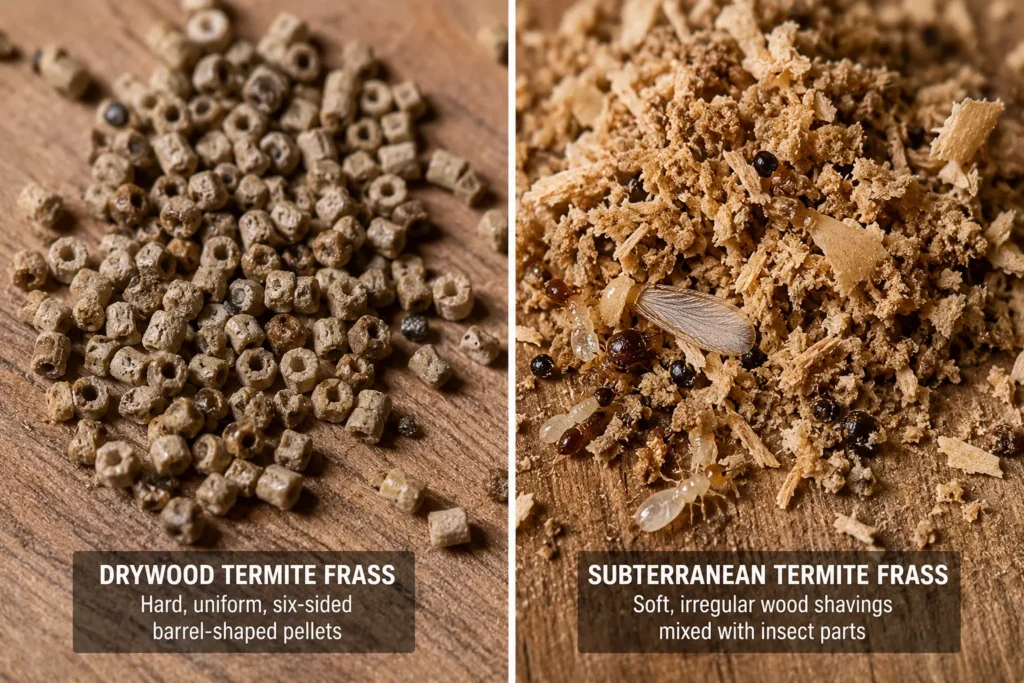
The fastest way to determine termite frass vs carpenter ant frass is by closely examining the debris pile. Drywood termite frass consists of hard, uniform, six-sided pellets that are about 1/25 of an inch long and look like coarse sand or coffee grounds. Carpenter ant frass, on the other hand, looks like soft, irregular pencil shavings mixed with dead insect parts, soil, and insulation. If you spot perfectly uniform, hard pellets, you are dealing with drywood termites. If the pile is a messy mix of chewed wood fibers and bug parts, carpenter ants are destroying your wood.
Identification Guide: Visual Signs of an Infestation
Correctly identifying the debris left behind by wood-destroying insects dictates the treatment protocol. Both pests excavate wood, but they do it for completely different reasons, which directly affects what they leave behind.
Signs of Drywood Termite Frass:
- Shape: Perfectly uniform, barrel-shaped pellets with six longitudinal indentations on the sides.
- Texture: Hard and dry. They roll easily if you try to pinch them between your fingers.
- Content: 100% digested wood. Termites eat the wood for nutrition, so there are never any insect parts or soil mixed in.
- Location: Found in cone-shaped piles directly beneath tiny “kick-out” holes (about 1/16 of an inch wide) in wooden frames, baseboards, or furniture.
Signs of Carpenter Ant Frass:
- Shape: Highly irregular, resembling miniature pencil shavings or sawdust created by a fine-toothed saw.
- Texture: Soft and fibrous.
- Content: Contains chewed wood fibers, dead worker ants, discarded wings, and sometimes bits of foam insulation or soil. Ants do not eat wood; they only excavate it to build nests.
- Location: Swept out of slit-like openings and found collecting on window sills, basement floors, or in crawlspaces.
Properly analyzing this debris is critical before moving forward, as it helps you avoid misdiagnosing the issue, a common mistake similar to confusing termite damage vs wood rot.
Root Causes: Why Are They in Your House?
Pests do not enter your home by accident. They invade because specific environmental conditions in your house or yard support their survival.
Carpenter ants are highly dependent on moisture. They target wood that has been softened by water damage, such as areas around leaky pipes, poorly sealed windows, or overflowing gutters. If you have moisture pooling within 3 feet of your foundation, you are inviting a carpenter ant colony to move in.
Drywood termites, however, do not require ground contact or excessive moisture. They pull the water they need directly from the humidity in the air and the wood itself. They typically swarm in late summer and enter homes through exposed, untreated wood in attics, eaves, or window frames. Subterranean termites—a different species—require immense moisture and build mud tubes, but they do not leave behind the dry frass piles discussed here.
Step-by-Step Solution: Professional Eradication Protocols
Do not rely on peppermint oil or DIY vinegar sprays. Once you have confirmed an active infestation inside structural wood, you must deploy professional-grade chemicals to eradicate the colony completely.
Protocol for Carpenter Ants:
- Locate the Nest: Follow the trailing ants at night. Tap the wood near the frass pile with a screwdriver handle. A hollow sound indicates a gallery.
- Apply Non-Repellent Spray: Spray the exterior perimeter of your home (up 2 feet and out 2 feet) with Taurus SC or Termidor SC (Fipronil). Mix exactly 0.8 oz per 1 gallon of water. Ants will cross the barrier without detecting it and carry the poison back to the queen.
- Deploy Indoor Baits: Inside, place Advion Ant Gel Bait in 1/4 inch beads near the frass piles. Do not spray contact killers like Spectracide or Raid indoors, as this will cause the colony to panic, split, and establish new nests elsewhere in the house.
Protocol for Drywood Termites:
- Pinpoint the Kick-Out Holes: Find the exact 1/16 inch holes where the frass is being expelled. Carefully inspect the surrounding walls for signs of termites in drywall to gauge the extent of the damage.
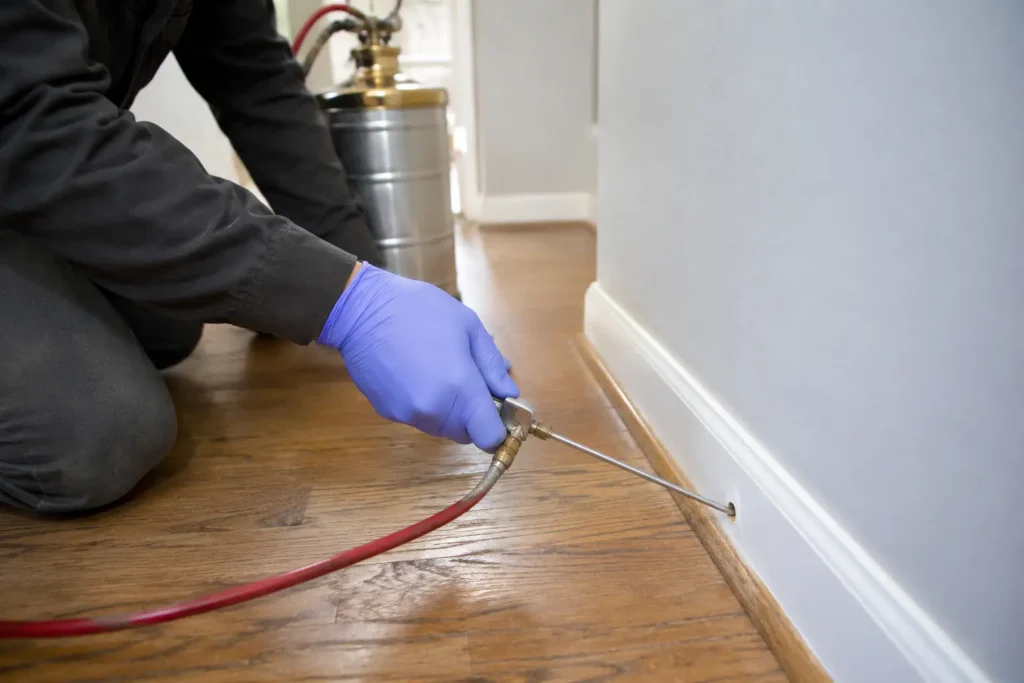
- Inject Foaming Termiticide: Drill a 1/8 inch hole directly into the termite gallery. Inject a specialized foam like Termidor Foam or Premise Foam. The foam expands at a 30:1 ratio, filling the intricate galleries and coating the termites in the lethal active ingredient.
- Treat Raw Wood: For exposed, unpainted wood in attics or crawlspaces, spray BoraCare directly onto the surface. Mix it at a 1:1 ratio with warm water. This borate treatment penetrates the wood fibers, killing active termites and protecting the wood for the life of the structure.
Expert Comparison: Wood-Destroying Pest Debris vs. Construction Sawdust
Homeowners frequently panic when they find sawdust under a doorframe or baseboard, immediately assuming an active infestation. It is vital to differentiate pest debris from normal construction dust or wear-and-tear.
If a door is sagging and rubbing against a hardwood floor, the resulting dust will be powdery and uniformly colored, matching the exact stain of the floor. It will not contain insect parts, nor will it form perfect six-sided pellets. Normal sawdust from recent renovations or settling will lack the distinct “kick-out” holes located directly above the pile. Always look up; pest frass falls from a distinct exit point, whereas construction dust settles everywhere.
PRO-TIP FROM THE FIELD: Never vacuum a frass pile immediately. Instead, place a piece of white paper directly under the suspected kick-out hole and wait 24 hours. If new frass accumulates on the paper, you have confirmed an active, ongoing infestation rather than old debris falling from structural vibrations.
What to Read Next
Once you have identified carpenter ants as the culprits, deploying a slow-acting stomach poison is the most effective way to eliminate the entire colony, including the queen. Read our detailed guide on how to use boric acid for carpenter ants to learn the precise mixing ratios and bait placements necessary to wipe them out permanently.
People Also Ask (FAQ)
Do carpenter ants eat wood?
No, carpenter ants do not eat wood for nutritional value. Their primary diet consists of proteins and sugars, such as dead insects and honeydew. They use their powerful mandibles to excavate softened or decaying wood strictly to create smooth, hollow galleries for nesting and expanding their colony.
Is termite frass harmful to touch?
Termite frass itself is not toxic or harmful to touch, as it is composed entirely of digested natural wood fibers. However, the presence of frass indicates a severe structural problem, and the dust can act as a mild respiratory irritant if inhaled in large, enclosed quantities like an attic space.
How fast do termites cause structural damage?
While a single termite eats wood very slowly, a mature colony containing up to two million workers can consume roughly 1 pound of wood in a single day. Without professional intervention using products like Fipronil or Bifenthrin, a colony can compromise load-bearing beams and structural integrity within three to five years.