
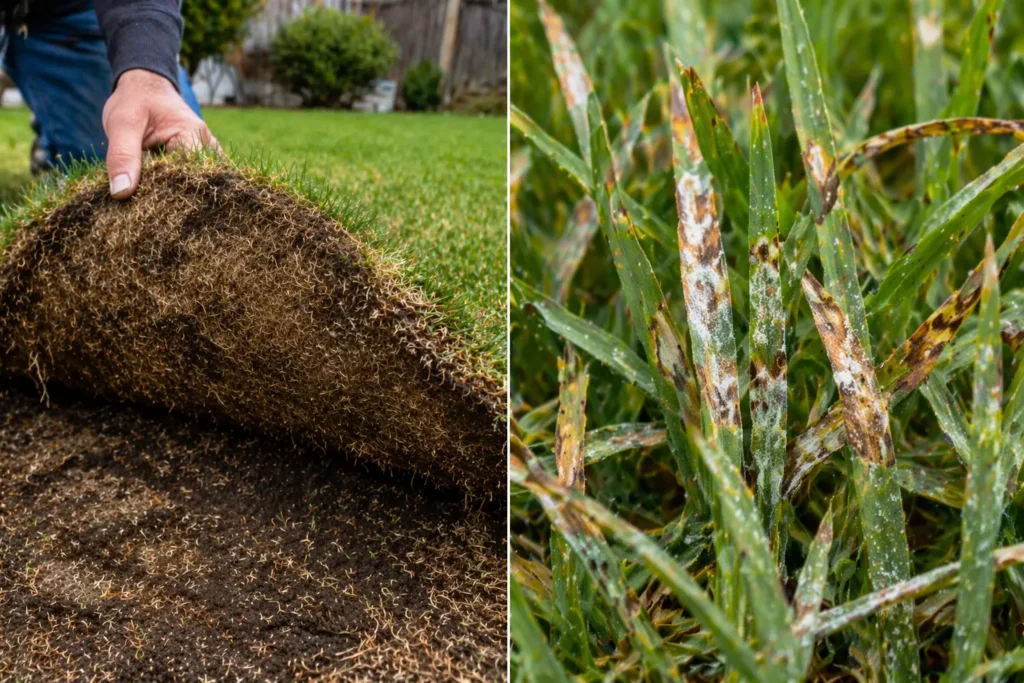
Is your yard turning brown, and you aren’t sure who the culprit is? Pull up a handful of the dead grass right now.
If the turf easily peels back like a loose carpet with no roots attached, you have a grub infestation.
If the grass stays firmly rooted but the blades are covered in spots, powdery dust, or forming distinct circular rings, you are dealing with a lawn fungus.
Identifying the Real Culprit: Grub Damage vs Fungus
Accurate identification is the critical first step in lawn care. Treating a fungus with a pesticide wastes money, and spraying fungicide on beetles won’t save your yard.
Here are the unmistakable signs that white grubs are actively destroying your turf roots:
- The Tug Test: The grass lifts effortlessly from the soil because the roots are completely eaten.
- Spongy Turf: Walking on the affected yard feels unusually soft or bouncy underfoot.
- Wildlife Damage: Raccoons, skunks, or flocks of birds are aggressively digging up your lawn to eat the larvae.
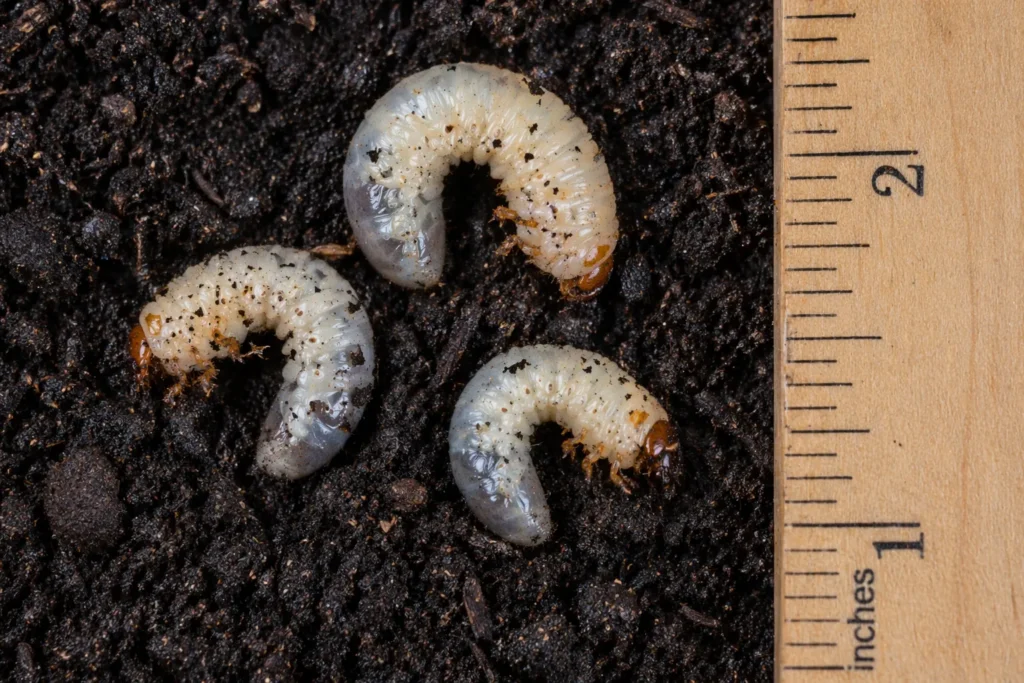
- Visual Confirmation: You dig down 1 to 2 inches and find more than 5 to 10 grubs per sq ft.
Lawn fungal diseases operate differently, attacking the foliage or the crown rather than severing the deep roots.
Look for these 4 surefire symptoms of an active lawn fungus:
- Irregular Rings: Brown patches that form perfect circles, often with a darker “smoke ring” around the outer edge.
- Leaf Lesions: Individual grass blades display tan spots with dark brown borders.
- Mycelium Threads: Early in the morning, you see web-like, cottony growth on the grass blades.
- Solid Roots: The dead or dying grass remains firmly anchored into the topsoil when pulled.
Cool-Season vs Warm-Season Vulnerabilities
Location and grass type dictate exactly which threat is most likely destroying your yard.
In Northern states, cool-season grasses like Kentucky Bluegrass and Tall Fescue are prime targets for Japanese beetle grubs in late summer.
These Northern lawns are also highly susceptible to fungal issues like Dollar Spot and Snow Mold when temperatures fluctuate between 50°F and 70°F.
In Southern states, warm-season yards featuring Bermuda, Zoysia, or St. Augustine grass face different seasonal threats.
Southern lawns frequently battle Large Patch fungus in the spring and fall when soil temperatures dip below 70°F, while facing distinct Southern masked chafer grubs.
Root Causes of Turf Death
To fix the problem permanently, you must understand the environmental triggers that invite these issues.
The root cause of grub damage is the life cycle of scarab beetles, such as Japanese beetles or June bugs.
Adult beetles fly into your yard in mid-summer, burrowing into the top 2 inches of soil to lay eggs. When these eggs hatch in late summer, the ravenous larvae immediately begin devouring grass roots.
Fungus, on the other hand, is caused by poor cultural practices and highly specific weather conditions.
The primary root causes of lawn disease outbreaks include:
- Overwatering at Night: Leaving grass wet overnight allows fungal spores to germinate.
- High Humidity: Extended periods of high humidity combined with nighttime temperatures above 65°F.
- Soil Compaction: Hard, compacted clay soils prevent proper drainage, trapping moisture at the crown.
- Excess Nitrogen: Applying too much quick-release fertilizer forces rapid, weak blade growth that disease easily attacks.
Step-by-Step Treatments for Grub Worms
If you find active grubs destroying your yard right now, you need a fast-acting curative treatment to stop the bleeding.
- Step 1: Purchase a curative insecticide containing Trichlorfon or Carbaryl, such as BioAdvanced 24 Hour Grub Killer Plus.
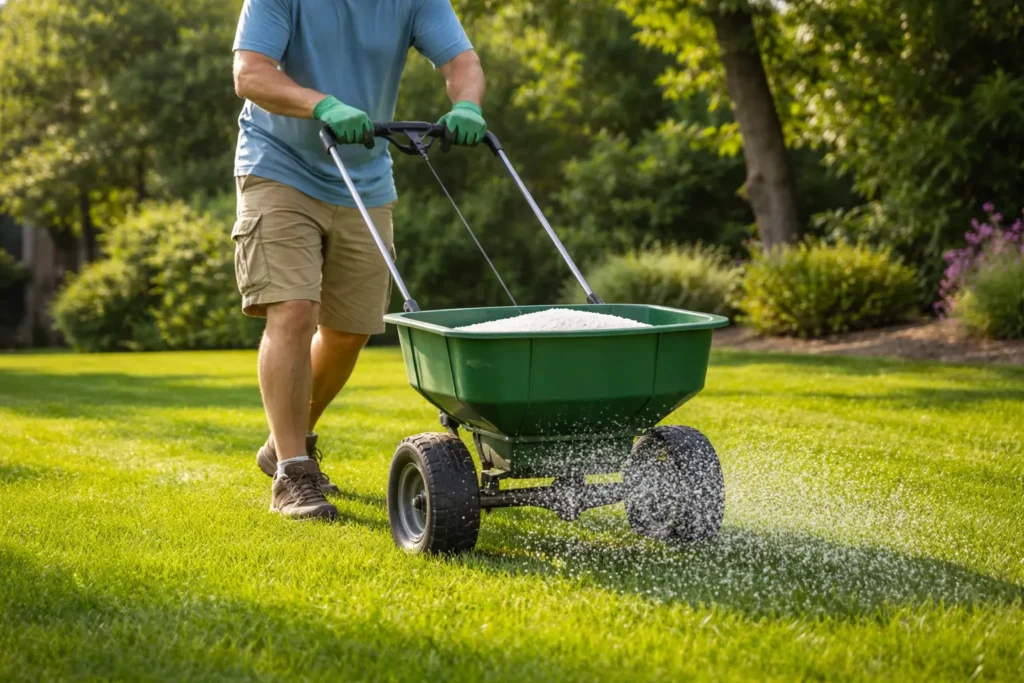
- Step 2: Apply the granular product using a broadcast spreader at a rate of 2 to 3 lbs per 1,000 sq ft, depending on the exact label instructions.
- Step 3: Immediately water the lawn with at least 0.5 inches of water. This pushes the chemical down into the root zone where the grubs are feeding.
To prevent future damage, timing is everything. Preventative applications are much more effective than reactive treatments.
Apply a preventative product containing Chlorantraniliprole, like Scotts GrubEx, in late spring or early summer before the beetles lay their eggs.
Step-by-Step Treatments for Lawn Fungus
Fungus control requires a combination of immediate chemical intervention and long-term cultural changes to dry out the turf canopy.
- Step 1: Apply a broad-spectrum systemic fungicide containing Propiconazole or Azoxystrobin.
- Step 2: Use reliable commercial products like Heritage G or Ortho Disease B Gon, applying uniformly across the diseased areas and a 3-foot perimeter around them.
- Step 3: Reapply the fungicide every 14 to 28 days as long as weather conditions favor disease development.
Chemicals alone will not permanently solve a fungal issue if your watering habits remain flawed.
Change your irrigation schedule immediately to water deeply but infrequently.
Apply exactly 1 inch to 1.5 inches of water per week, strictly between 4:00 AM and 8:00 AM so the sun can dry the grass blades quickly.

People Also Ask
Can you apply grub control and fungicide at the same time?
Yes, you can safely apply granular grub control and a systemic fungicide on the same day. However, it is best practice to apply the grub control first, water it in deeply with 0.5 inches of water to reach the soil, let the grass blades dry, and then apply the fungicide to the foliage.
Will dead grass from grubs grow back?
If the root system is entirely severed and the turf is fully brown, that specific grass plant is dead and will not regenerate. You will need to rake out the dead organic matter and reseed the bare patches with a premium seed mix at a rate of 4 to 8 lbs per 1,000 sq ft, depending on the grass type.
What temperature kills lawn fungus?
Most common lawn fungi go dormant when extreme weather hits, but the exact temperature depends on the pathogen. For example, Brown Patch thrives in hot weather but stops spreading when temperatures drop below 65°F, while cool-weather diseases like Snow Mold die off quickly once temperatures consistently exceed 60°F.