
That ugly black mold on lawn blades is almost always a harmless organism called slime mold. It uses your turf as an anchor while feeding on decaying organic matter, not the grass itself. You can easily clear it up by lightly raking the affected area, mowing, or blasting it off with a strong stream of water from your hose.
Finding a dark, sooty patch in your yard can send any homeowner into a panic. Before you rush to douse your yard in heavy chemicals, you need to know exactly what you are dealing with.
As a certified lawn care specialist, I see this issue peak during the wet, warm seasons. Let’s break down how to properly identify this issue and get your yard looking pristine again.
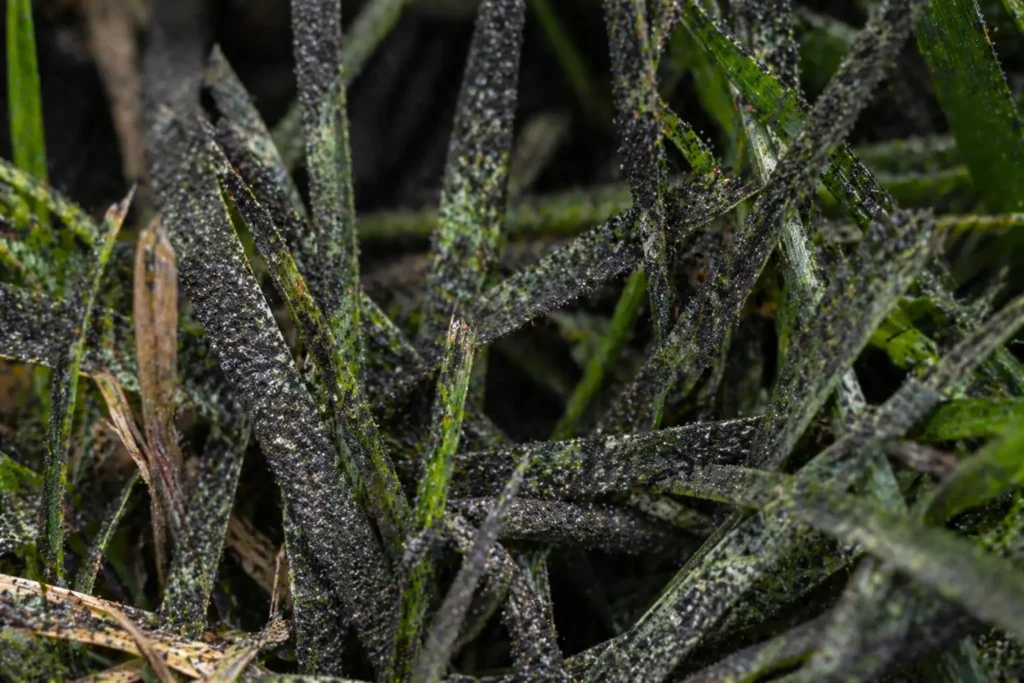
Identification Guide: Is It Really Slime Mold?
Proper diagnosis is the first rule of professional lawn care. If you misidentify the problem, you will waste money on the wrong treatments. Look for these undeniable signs:
- Sooty Appearance: The grass blades look like they are covered in cigarette ash, black powder, or dark gray soot.
- Easy to Wipe Off: If you run your finger (wear a glove) along the blade, the black residue wipes off easily, revealing healthy green grass underneath.
- Sudden Onset: The patches appear almost overnight, usually right after a heavy rainstorm or an extended period of high humidity.
- Irregular Shapes: The patches are usually circular or irregular, ranging from a few inches to roughly 2 feet in diameter.
- No Immediate Yellowing: Unlike root rot or severe fungal infections, the grass does not immediately turn yellow or die back.
Root Causes: Why Your Yard Looks Like a Sooty Mess
Slime mold spores are everywhere in the environment. They wait for the perfect storm of environmental conditions to activate and multiply.
The most common trigger is excessive moisture. Extended periods of rain, heavy morning dew, or overwatering your yard creates a micro-climate where fungi thrive. When temperatures sit between 60°F and 80°F, slime mold moves from the soil up onto the grass blades to reproduce.
Another massive culprit is a thick thatch layer. Thatch is the layer of dead stems and roots between the soil and the green grass. If your thatch layer exceeds 1/2 inch, it acts like a sponge, trapping moisture and providing a buffet of decaying organic matter for the mold.
Finally, poor drainage and compacted soil keep moisture trapped at the surface. If your yard resembles a swamp hours after a storm, you are rolling out the red carpet for fungal issues.
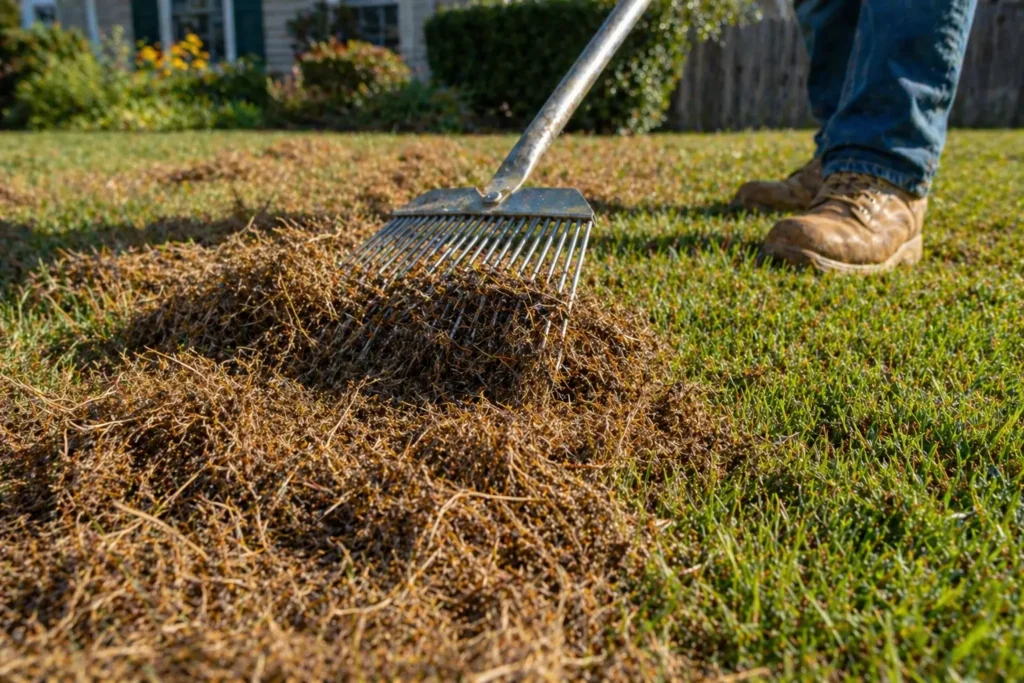
Step-by-Step Solution: Eradicating the Mold
Because slime mold doesn’t extract nutrients from your grass, treating it is more about mechanical removal and moisture management than heavy chemical warfare. Follow these professional steps.
- Step 1: Mechanical Disruption. Take a standard leaf rake or a stiff broom and gently brush the affected patches. Breaking up the spore masses stops the reproduction cycle and exposes the fungus to drying sunlight.
- Step 2: The Wash Down. It sounds counterintuitive to add water to a fungus, but a sharp blast from your hose will knock the mold off the blades and down into the soil where it belongs. Do this in the morning so the grass dries by nightfall.
- Step 3: Proper Mowing. Mow your grass. If you have cool-season turf like Kentucky Bluegrass or Tall Fescue, keep it around 3 inches tall. Bag your clippings during this mow to physically remove the spore clusters from the yard.
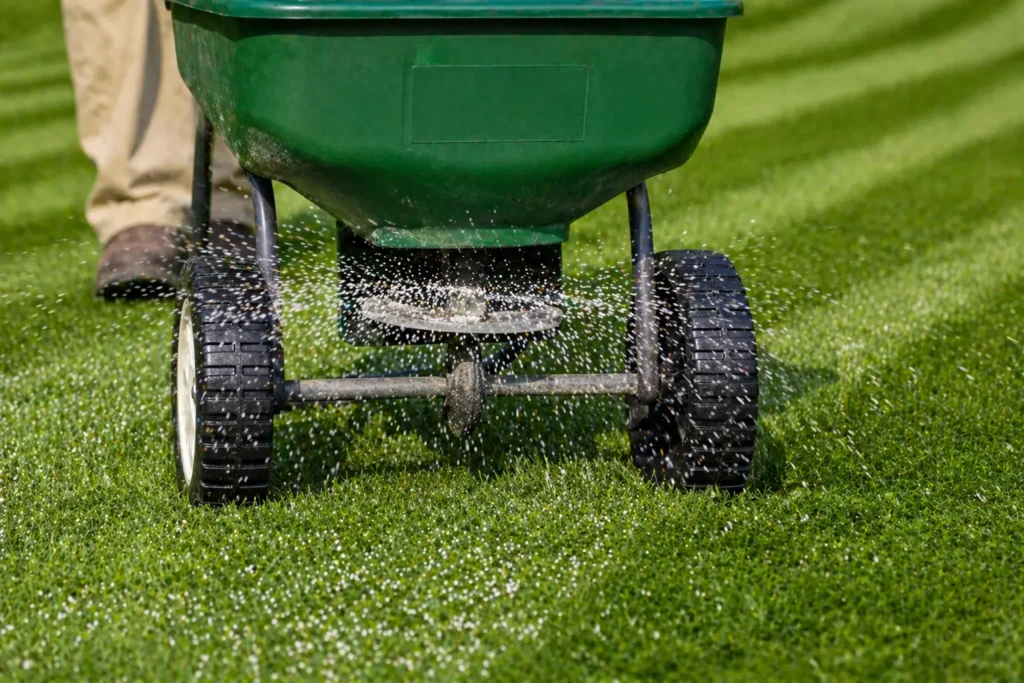
- Step 4: Chemical Intervention (Optional). Generally, fungicides are a waste of money for slime mold. However, if the mold is so thick it is blocking sunlight and causing the grass to yellow, you can apply a localized treatment. Use a product containing Mancozeb or a broad-spectrum fungicide like Scotts DiseaseEx (which uses Azoxystrobin). Apply exactly at the bag rate using a broadcast spreader.
Expert Comparison: Slime Mold vs. Turf Diseases
Homeowners often confuse slime mold with actual destructive lawn diseases. Let’s clear up the confusion so you don’t over-treat your yard.
- Slime Mold vs. Leaf Spot: Leaf spot creates distinct dark, purplish-black lesions inside the grass tissue. You cannot wipe it off. Slime mold is purely surface-level dust.
- Slime Mold vs. Pythium Blight: Pythium Blight looks like greasy, dark, water-soaked grass that quickly dies and mats together, often accompanied by white, cottony mycelium. It is highly destructive and requires immediate application of Mefenoxam.
- Slime Mold vs. Sooty Mold: Sooty mold occurs under trees infested with aphids. The aphids excrete sticky “honeydew” onto the lawn below, and black mold grows on the sugar. You must treat the tree pests (e.g., using Imidacloprid) to fix this, not the grass.
Pro-Tips Box: > From Professional to Homeowner: Preventative maintenance is your best fungicide. Core aerate your lawn every fall to relieve soil compaction and improve drainage. Keep your watering strictly to 1 to 1.5 inches per week, delivered in one or two deep soakings early in the morning, rather than shallow daily watering.
What to Read Next
If your turf discoloration isn’t a sooty black surface issue, you are likely dealing with a more serious root or tissue problem that requires immediate action. Check out our guide on fixing yellow spots on grass to successfully rule out nutrient deficiencies, dog damage, and pests. For aggressive, dying circles spreading across your yard, read our expert comparison on Brown Patch vs. Dollar Spot to stop destructive summer diseases in their tracks before they ruin your lawn.
People Also Ask (FAQ)
Is black mold on grass dangerous to dogs?
No. The slime mold typically found on lawns is non-toxic and harmless to dogs, cats, and humans. However, if your pet has severe respiratory allergies or asthma, inhaling a concentrated cloud of spores if they roll in it could cause mild sneezing or irritation.
Will black mold kill my grass?
Slime mold does not infect or feed on the living grass tissue. The only way it damages turf is by creating such a thick, dark crust that it blocks sunlight, which can temporarily cause the grass blades to turn yellow from lack of photosynthesis.
How long does lawn slime mold last?
Under normal conditions, a slime mold outbreak is entirely cosmetic and will disappear on its own within one to two weeks once the weather dries out. You can speed up this timeline to just a few days by raking or mowing the affected area.