
The fastest way to tell the difference is by looking at the lesion pattern on the grass blade and the size of the affected area. Brown patch typically creates large, circular patterns up to 3 feet wide, while dollar spot produces small, silver-dollar-sized circles rarely exceeding 6 inches.
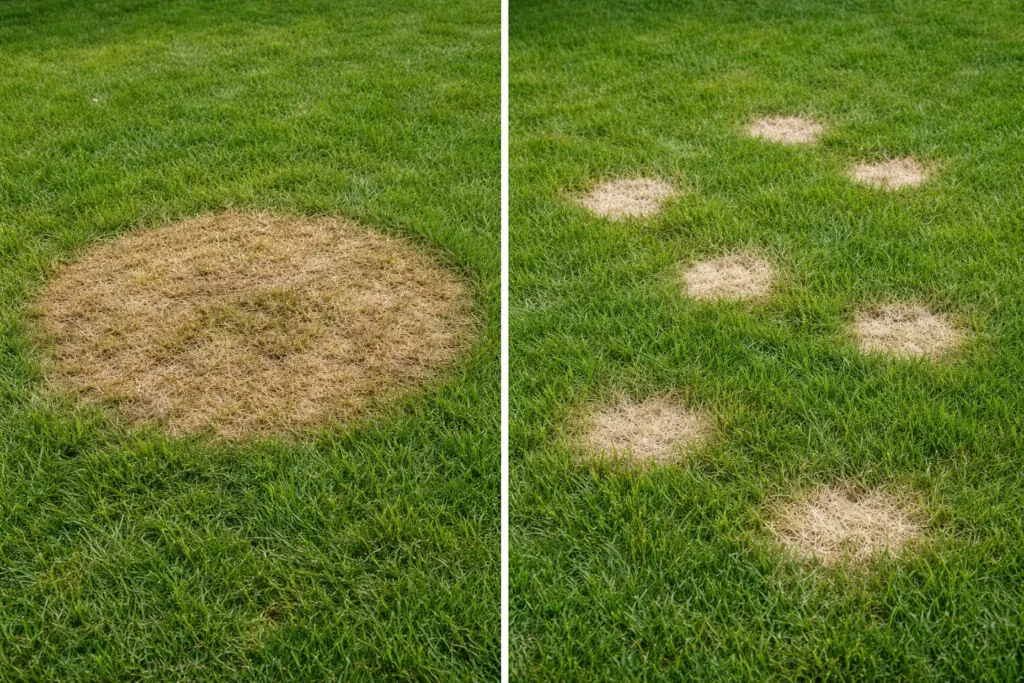
Identifying Brown Patch (Rhizoctonia solani)
Brown patch is a fungal nightmare for warm-season grasses like St. Augustine and Zoysia in the South, but it also hits Tall Fescue in the transition zone.
Look for these specific signs:
- The “Smoke Ring”: A dark, grayish-black outer rim visible in the early morning when the grass is wet.
- Large Circles: Patches that range from 6 inches to over 3 feet in diameter.
- Easy Pull: Affected grass blades pull away easily from the stolon because the base of the leaf sheath has rotted.
- Leaf Lesions: Tan lesions with dark brown borders that don’t necessarily span the entire width of the blade.
Identifying Dollar Spot (Clarireedia jacksonii)
Dollar spot thrives on cool-season grasses like Kentucky Bluegrass and Bentgrass, but it is notorious for attacking lawns with low nitrogen levels.
Key identifiers include:
- Size: Small, sunken, straw-colored spots roughly the size of a silver dollar.
- The Hourglass Lesion: This is the “smoking gun.” Lesions on the leaf blade are bleached white and shaped like an hourglass, cinched in the middle.
- Mycelium: In heavy dew, you will see white, cobweb-like growths (mycelium) covering the spots.
- Widespread Pitting: While spots start small, they can coalesce into large, irregular bleached areas if left untreated.
Root Causes: Why Is Your Yard Dying?
Understanding the environmental triggers is crucial for choosing the right treatment strategy. Both fungi thrive in humidity, but their temperature preferences differ.
Causes of Brown Patch
- High Temperature/Humidity: It peaks when night temperatures stay above 65°F and day temperatures hit 80°F or higher.
- Excess Nitrogen: Over-fertilizing with fast-release nitrogen during hot, humid spells is like pouring gasoline on a fire.
- Evening Watering: Leaving the turf canopy wet for more than 10 hours overnight.
Causes of Dollar Spot
- Nitrogen Deficiency: Unlike brown patch, dollar spot loves “hungry” lawns. If you haven’t fertilized, your lawn is at risk.
- Drought Stress: Lawns that are kept too dry or have deep thatch layers (over 0.5 inches) are susceptible.
- Extended Leaf Wetness: Heavy dew or frequent light irrigation that doesn’t reach the roots.
Step-by-Step Treatment and Solutions
Once you have identified the exact fungus attacking your turf, you must act aggressively to stop the spread before it kills the plant down to the root crown. You cannot spray your way out of bad cultural practices, so treatment requires a two-pronged approach: chemical knockdown and environmental correction.
Step 1: Apply the Right Fungicide
Liquid treatments work faster for curative control, while granulars are better for prevention.
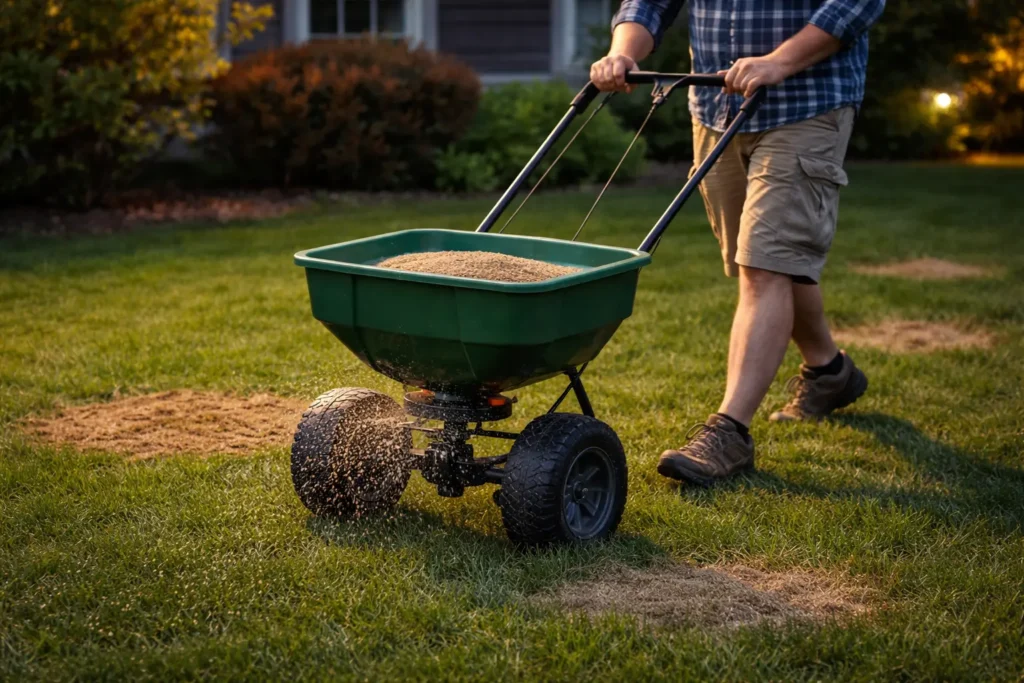
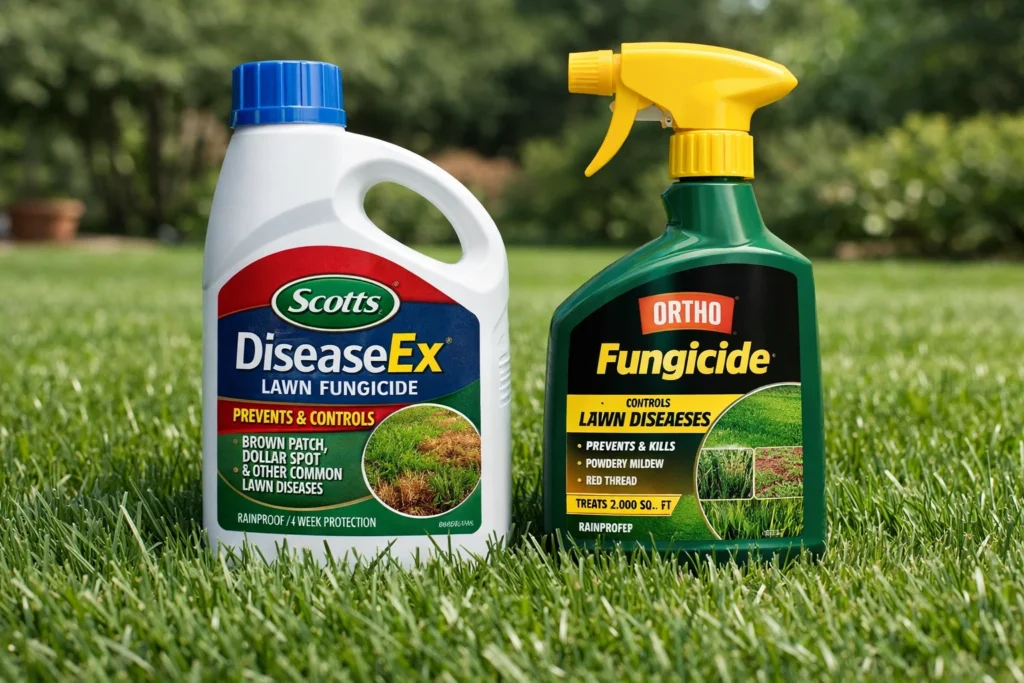
- For Brown Patch: You need a Group 11 fungicide like Azoxystrobin. Apply Heritage G (granular) using a broadcast spreader at a curative rate of 4 lbs per 1,000 sq ft. For liquid applications, mix Spectracide Immunox at 2 fl oz per gallon of water in a backpack sprayer, covering 500 sq ft per gallon.
- For Dollar Spot: Use a Group 3 fungicide like Propiconazole. Apply BioAdvanced Fungus Control for Lawns at a rate of 2.5 to 3 lbs per 1,000 sq ft. If the hourglass lesions are widespread, alternate with Thiophanate-methyl (Clearys 3336F) to prevent the fungus from building resistance.
- Safety Tip: Always wear long pants, closed-toe shoes, and chemical-resistant gloves when applying fungicides. Keep pets and children off the treated lawn until liquid sprays have dried completely or granulars have been watered in with exactly 0.25 inches of irrigation.
Step 2: Correct Your Nitrogen Inputs
Your fertilizer strategy dictates recovery. If you have Brown Patch, immediately halt all fast-release nitrogen applications, which actively fuel the disease. If you have Dollar Spot, lightly spoon-feed the lawn with 0.2 lbs of quick-release nitrogen per 1,000 sq ft (like urea) to help the grass outgrow the bleached lesions.
Step 3: Modify the Environment
Adjust your irrigation timer immediately. Water deeply but infrequently—aiming for 1 to 1.5 inches per week—and only between 4:00 AM and 8:00 AM. Evening watering keeps the grass blades wet for over 10 hours, creating the perfect incubation chamber for mycelium. Finally, raise your mower deck to 3.5 or 4 inches to reduce plant stress while the turf heals.
Comparison: Symptoms vs. Common Confusions
It is easy to mistake fungal disease for other issues like pest damage or chemical burns. Use this table to differentiate.
| Feature | Brown Patch | Dollar Spot | Grubs / Chinch Bugs |
| Spot Size | 6″ to 36″ | 1″ to 6″ | Irregular patches |
| Key Sign | Dark “smoke ring” border | Hourglass leaf lesion | Grass peels up like carpet |
| Fertilizer Effect | Nitrogen makes it worse | Nitrogen helps it heal | No effect |
| Primary Grass | St. Augustine, Zoysia, Fescue | Bluegrass, Ryegrass, Bentgrass | All types |
To wrap up your lawn recovery plan, remember that healthy soil is the best defense against fungal outbreaks. If you struggle with persistent Brown Patch or Dollar Spot, your soil might be too compacted for proper drainage and airflow. Learn how to open up your turf and strengthen root systems by checking out our expert guide on When Should You Aerate Your Lawn? to ensure your next treatment delivers maximum results.
Prevention Tips
Preventing brown patch and dollar spot requires a strict lawn care schedule, not just reactive chemical applications. First, implement a targeted nitrogen strategy. For cool-season grasses prone to dollar spot, apply a slow-release nitrogen fertilizer like Milorganite in late spring to maintain steady growth without forcing an unnatural flush. For warm-season lawns susceptible to brown patch, avoid fast-release nitrogen entirely during the highly humid months of July and August. Second, manage your moisture. Run your irrigation system only between 4:00 AM and 8:00 AM to wash off fungal-promoting dew while allowing the morning sun to dry the turf canopy quickly. Finally, manage your thatch. If your thatch layer exceeds 0.5 inches, rent a core aerator or dethatcher in the early fall. A thick thatch layer acts as a permanent sponge, holding moisture and harboring fungal spores year-round.
Pro-Tips Box: Pro Tip: Never apply a curative rate of fungicide as a preventative measure. It wastes money and accelerates chemical resistance in your turf. Instead, track your local soil temperatures closely. Brown patch spores activate when soil temps reach 65°F. Use a digital meat thermometer pushed two inches into the dirt to monitor this. Once you hit that 65°F threshold consistently for three days, put down a preventative half-rate of a granular Group 11 fungicide like Azoxystrobin. This stops the disease before those ugly smoke rings ever appear.
People Also Ask (FAQ)
Can I mow my lawn if I have brown patch or dollar spot?
Yes, but you must be extremely careful not to spread the fungal spores to healthy sections of your yard. Always mow the diseased areas last, and wash the underside of your mower deck with a bleach-water solution afterward. Bag your clippings instead of mulching them to remove the infected plant tissue from the lawn.
How long does it take for the grass to recover after treatment?
Fungicides are “preventatives” or “curatives” that stop the fungus, but they do not instantly regrow the grass. After applying a product like Scotts DiseaseEx, the fungus should stop spreading within 48 to 72 hours. However, visible recovery of the brown areas may take 3 to 6 weeks during the active growing season.
Is dollar spot dangerous to pets or humans?
The fungus itself is generally not harmful to humans or pets; however, the chemical treatments used to kill it require caution. After applying liquid or granular fungicides, keep pets and children off the yard until the product has been watered in and the grass is completely dry to prevent skin irritation or accidental ingestion.