
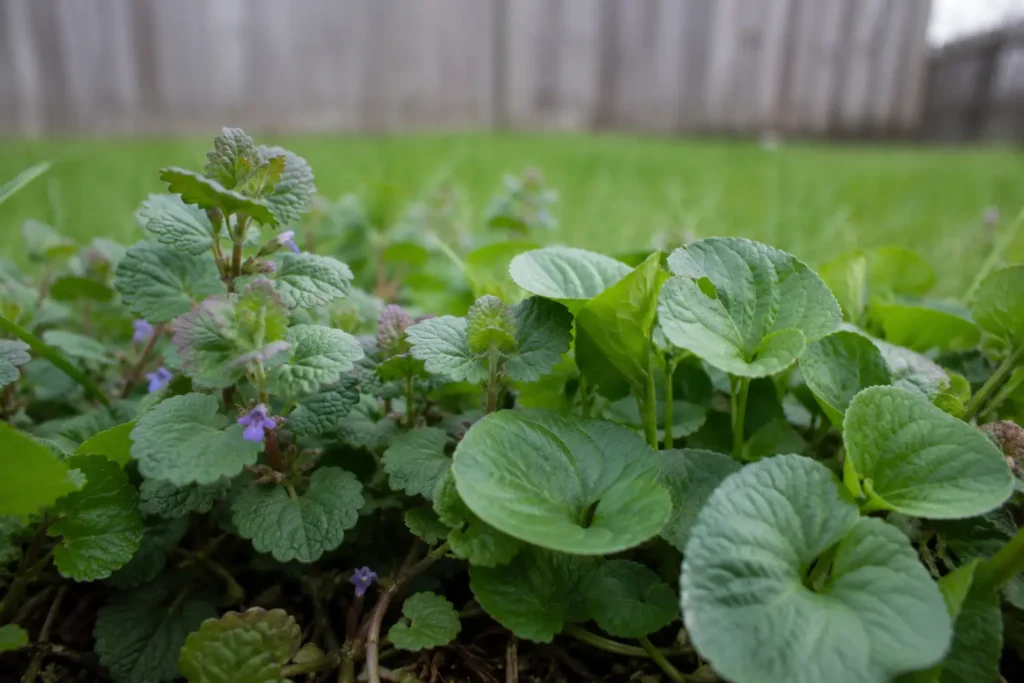
Both weeds produce small purple flowers, but creeping charlie grows on trailing vines with scalloped, coin-shaped leaves and emits a strong minty odor when crushed. Wild violet grows in individual clumps with distinct heart-shaped leaves and lacks any smell. Treating them requires a post-emergent herbicide containing Triclopyr; standard 2,4-D weed killers will fail.
Creeping Charlie vs Wild Violet at a Glance
| Creeping Charlie Glechoma hederacea | Wild Violet Viola sororia | |
| Crushed leaf smell | Strong mint – the test that never fails | None at all |
| Leaf shape | Round and coin-like with scalloped edges | Heart-shaped with a waxy coating |
| How it spreads | Runners (stolons) that root at every node | Underground rhizomes and tubers |
| Growth habit | Creeps flat across the soil in a mat | Dense isolated clumps; does not crawl |
| Flowers | Tiny tubular bluish-purple, in spring | Five petals, purple, slightly larger |
| Herbicide that works | Triclopyr | Triclopyr – 2,4-D fails on the waxy leaf |
| Surfactant | Helpful | Essential – 1/2 oz non-ionic per gallon |
| Best time to spray | Mid to late fall, after the first light frost | Mid to late fall, after the first light frost |
| Time to full kill | 2 to 3 weeks | 2 to 3 weeks |
| Second application | Sometimes needed | Almost always – 14 to 21 days later |
| Soil it prefers | Compacted clay that drains poorly | Nitrogen-depleted soil |
Both weeds throw small purple flowers in spring, which is why they get confused constantly. Ignore the flowers. Crush a leaf between your fingers: mint means creeping charlie, no smell means wild violet. That single test decides your entire tank mix, and it works in any season the plant has leaves.
The expensive mistake: reaching for a standard 2,4-D weed killer. It beads straight off the waxy cuticle of a wild violet leaf and does essentially nothing. You need triclopyr, and on violets you need a surfactant with it or the spray never makes contact.
Telling Them Apart in the Yard
You need to know your enemy before mixing chemicals in your tank. Grab a sample from your yard and check these specific traits.
Creeping Charlie (Glechoma hederacea):
- Growth pattern: Spreads rapidly via runners (stolons) that root at the nodes. It literally creeps across the top of your soil, matting tightly against the ground.
- Leaf shape: Round, coin-like with scalloped edges.
- Scent: Crush a leaf between your fingers. If it smells like pungent mint, you have creeping charlie. This is a field test that never fails.
- Flowers: Tiny, tubular, bluish-purple flowers blooming in spring.
- Growth pattern: Grows in dense, isolated clumps connected by a thick underground root system (rhizomes). It doesn’t crawl.
- Leaf shape: Distinctly heart-shaped with a waxy coating. That waxy layer makes liquid herbicides bead up and roll off.
- Scent: Completely odorless.
- Flowers: Five-petaled purple or violet flowers, slightly larger than creeping charlie’s.
Most homeowners call me complaining about “purple weeds taking over.” I walk the yard, snap a stem, and sniff it. That instantly tells me what tank mix we’re mixing up.
What Their Presence Says About Your Soil
Weeds are messengers. They tell you exactly what is wrong with your soil. If you have a massive infestation of either of these broadleaf weeds, your lawn environment is failing.
Both plants aggressively outcompete turfgrass in damp, heavily shaded areas. You will usually find them thriving under mature oak or maple trees where sunlight barely penetrates. The grass thins out, and the weeds move in.
Creeping charlie loves hard, compacted clay that drains poorly. Grass roots suffocate in this dense soil, but this weed thrives on it. Wild violets do exceptionally well in nitrogen-depleted soil. When your turf starves, weeds feast.
Low mowing heights also play a massive role. Scalping your lawn stresses the turf and invites invaders. If you mow your tall fescue below 3 inches, you are rolling out the red carpet. Fix the environment, or you’ll be fighting this chemical battle every single spring.
How to Kill Them: Chemical, Rate and Timing
Standard big-box weed killers won’t touch these two. You need specific active ingredients to break through their natural defenses.
- Choose the right chemical: Standard 2,4-D is virtually useless against the waxy leaves of wild violet. You need a systemic herbicide containing Triclopyr. Products like Ortho Weed B Gon Chickweed, Clover & Oxalis Killer or commercial-grade Hi-Yield Triclopyr Ester work best.
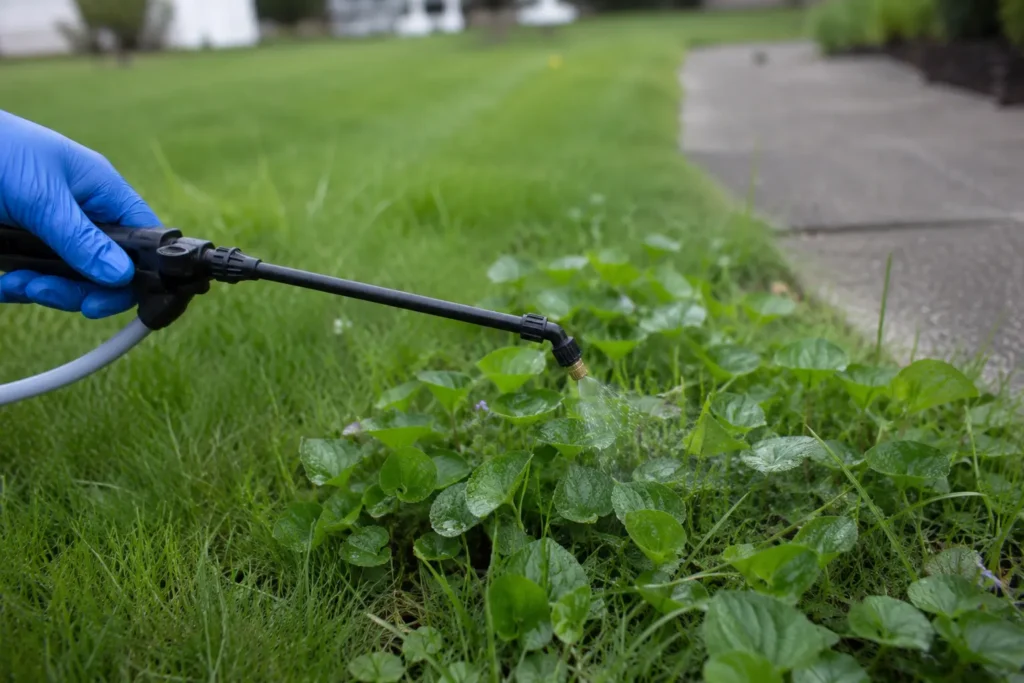
- Add a surfactant: Because wild violet leaves are thick and waxy, chemical sprays just bead off. Mix 1/2 oz of non-ionic surfactant per gallon of water in your pump sprayer. This breaks the surface tension and forces the poison to stick.
- Time the application: The absolute best time to kill both weeds is mid-to-late fall, right after the first light frost. The plants are pulling nutrients down into their roots for winter and will suck the herbicide down with it. Spring applications during the bloom are your second-best option. Wait for a day when temperatures are between 65°F and 85°F.
- Mix and spray: For a product like Hi-Yield Triclopyr 4, mix 3/8 to 3/4 oz per gallon of water to cover 1,000 sq ft of lawn. Coat the leaves evenly but don’t drench them to the point of runoff.
- Be patient: Triclopyr works slowly. You won’t see results overnight. The leaves will start curling after 5 to 7 days, and full death takes about 2 to 3 weeks.
- Re-apply: A single application rarely kills a mature patch of wild violet due to its massive underground tubers. Expect to do a second application 14 to 21 days later.
Keep kids and pets off the treated area until the spray has completely dried (usually 2 to 4 hours depending on humidity). I’ve had clients panic because they didn’t read the label and thought their dog was poisoned just by walking on dry grass. Brush up on how long after fertilizing is it safe for dogs to understand basic yard chemical safety principles.
Professional vs. DIY
| Factor | DIY | Professional |
| Cost | $ | $$$ |
| Speed | 3-4 Weeks | 2-3 Weeks |
| Effectiveness | Moderate | High |
| Risk | Moderate | Low |
DIY control is completely possible if you catch the weeds early. Buying a $30 bottle of Triclopyr and a hand sprayer is cheap and effective for spot treatments.
If your lawn is more than 30% creeping charlie or wild violet, DIY spot-treating becomes a losing game. Licensed pest control operators have access to restricted-use tank mixes and professional-grade surfactants that penetrate waxy cuticles better than retail products. If you’ve been spraying the same patch for two years and it keeps coming back, hire a certified lawn technician to blanket-spray the yard.
Common Misdiagnosis
Homeowners constantly misidentify these weeds. Treating the wrong plant wastes time and money.
The biggest mix-up is Henbit or Purple Deadnettle. Both have purple flowers and appear in early spring. Look at the stems. Henbit has distinctively square stems and grows upright (about 6 to 12 inches tall). Creeping charlie stays low to the ground on running vines.
Dichondra is another imposter. It has similar round, kidney-shaped leaves but lacks the purple flowers and prefers warm-season turf zones like Southern California or Florida.
Confirm what you’re spraying. Applying expensive Triclopyr to a weed that only needs a cheap, basic treatment is throwing money down the drain.
Prevention Tips
Killing the weeds is only half the job. You have to change the yard conditions so they don’t return next season.
First, fix soil compaction. Creeping charlie exploits hard soil. If you can’t push a screwdriver six inches into your lawn, you need to aerate. Figuring out exactly when should you aerate your lawn is your best long-term defense against shallow-rooted weeds.
Next, overseed bare spots. Weeds do not invade thick turf. Overseed your yard every fall to build a dense grass canopy that blocks sunlight from reaching dormant weed seeds.
Finally, prune tree branches. If the problem area is constantly in deep shade, thin out the tree canopy to allow more sunlight in. Moisture and darkness are your enemies.
Pro-Tips Box:
- The Mowing Mistake: Never mow right before or right after applying post-emergent herbicides. You need maximum leaf surface area to absorb the chemical. Always mow before weed and feed or liquid treatments, leaving at least a 2 to 3-day buffer before spraying.
- The Frost Trick: Hit wild violet with Triclopyr 24 to 48 hours after the first light frost in autumn. The frost naturally damages the weed’s waxy cuticle, allowing your herbicide to punch right through the plant’s defenses.
People Also Ask (FAQ)
Will creeping charlie choke out my grass?
Yes. It is an incredibly aggressive spreader. The vines mat tightly over the soil surface, blocking sunlight and stealing nutrients from your turf. Left unchecked, it will completely smother and kill large patches of your lawn.
Is creeping charlie toxic to dogs?
Yes, it is mildly toxic to dogs, cats, and horses. Ingestion can cause drooling, sweating, and upset stomach. The plant is bitter, and most pets will naturally avoid eating it.
Can I just pull wild violet by hand?
Hand-pulling rarely works. Wild violets have thick, resilient rhizomes deep in the soil. If you snap the top off and leave even a tiny piece of the root behind, the plant will regenerate within a few weeks.