
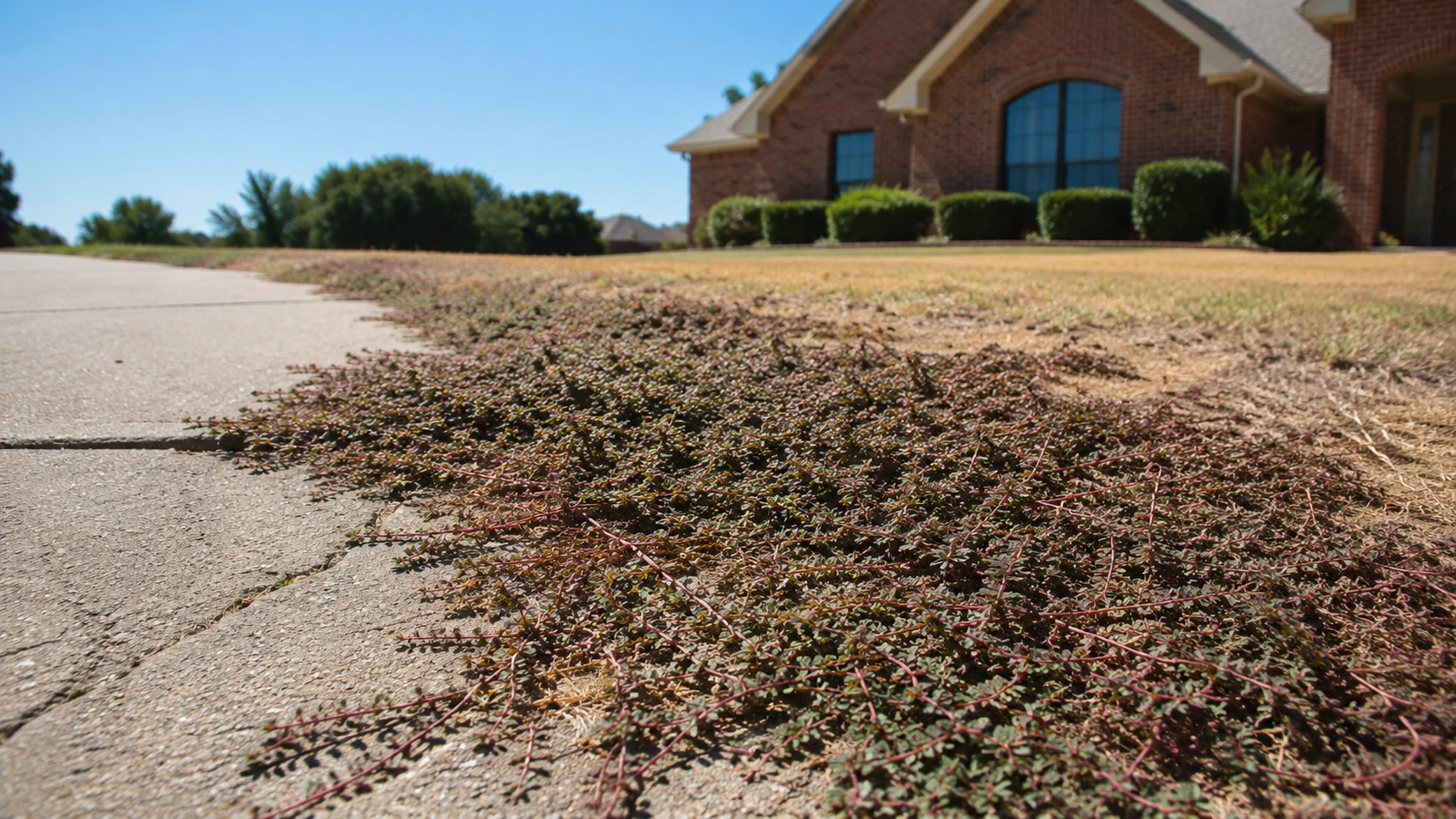
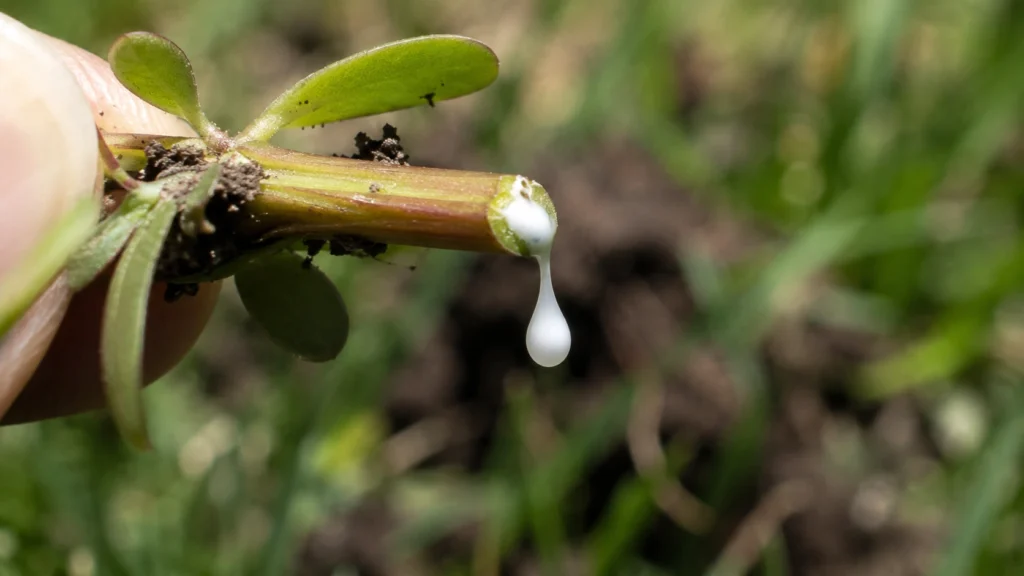
Break a stem in half. If a white, milky sap oozes out, you have spotted spurge. If the stem snaps clean and produces a clear, watery liquid, you are dealing with purslane. Both are low-growing, mat-forming summer annual weeds that thrive in bare patches, but they require slightly different eradication tactics to prevent them from taking over your yard completely.
Spurge vs Purslane at a Glance
| Spotted Spurge | Purslane | |
| Sap from a snapped stem | Milky white and sticky | Clear and watery |
| Leaves | Thin and flat, usually with a red or purple spot in the center | Thick, fleshy and succulent |
| Stems | Thin, highly branched, slightly hairy, pale green to pink | Thick, smooth, distinctly reddish-purple |
| Flowers | Tiny pinkish-white, clustered at the leaf bases | Small yellow, five petals, open in morning sun |
| Stems underfoot | Tough and wiry, resist damage | Break off easily |
| Spreads from broken pieces | No | Yes – every fragment can root |
| Toxic to pets | Yes – the sap irritates skin, mouth and stomach | No |
| Edible for people | No | Yes, if untreated |
| Gloves needed to pull | Yes – nitrile, the sap causes dermatitis | Not required, but bag every fragment |
| Herbicide that works | 2,4-D, dicamba or triclopyr | Same, plus glyphosate with MSO in beds |
| Pre-emergent | Prodiamine in early spring | Prodiamine in early spring |
If you only remember one row, make it the first one. The sap test settles it in ten seconds and it never gives a false answer, while leaf shape and stem color both shift with sun exposure and soil. Everything else in this table is confirmation.
Why it matters which one you have: purslane multiplies from every stem fragment you leave behind, so pulling it carelessly is how a small patch becomes a large one. Spurge does not do that, but its sap will give you contact dermatitis if you handle it bare-handed. Same treatment aisle, opposite handling mistakes.
Telling Them Apart in the Yard
Telling spurge vs purslane apart from a distance is nearly impossible. Both weeds hug the ground and form dense, circular mats in your lawn or sidewalk cracks. Up close, the differences are striking.
- The Sap Test: This is the definitive test. Snap a stem in half. Spurge leaks a sticky, milky white sap instantly. Purslane has a clear, watery juice.
- Leaf Texture: Purslane leaves are thick, fleshy, and succulent-like. Spurge leaves are thin, flat, and usually have a distinct red or purple spot directly in the center.
- Stem Color: Purslane stems are thick, smooth, and distinctively reddish-purple. Spurge stems are thin, highly branched, slightly hairy, and pale green or pinkish.
- Flowers: Purslane produces tiny yellow flowers with five petals that open only in the morning sun. Spurge features incredibly small, inconspicuous pinkish-white flowers clustered tightly near the base of the leaves.
- Growth Habit: Purslane stems break off easily when stepped on. Spurge stems are surprisingly tough and wiry, resisting physical damage.
Why They Showed Up in Your Yard
Nature abhors a vacuum. When your yard has exposed dirt, opportunistic seeds move in. Both spurge and purslane are aggressive summer annuals that thrive in brutal heat and compacted, poor-quality soil.
A thin lawn is the primary invitation. If your turfgrass isn’t dense enough to shade the soil surface, direct summer sunlight heats the ground and triggers weed seed germination. Spurge seeds need soil temperatures around 60°F to germinate, while purslane prefers it slightly warmer.
Compaction is your second biggest enemy. These flat weeds have shallow but aggressive taproots that penetrate hard, dry dirt where turfgrass roots suffocate. High-traffic areas, edges along concrete driveways, and scalped lawn sections are prime real estate. If your sprinkler heads don’t reach a certain corner and the soil bakes hard by July, expect to see these mats take over. They survive extreme drought conditions that easily kill off standard fescue or bluegrass.
How to Kill Each One Without Spreading It
Eradicating these weeds requires precision. Pulling them the wrong way will make the infestation dramatically worse.
Step 1: Identify and Protect
Perform the sap test. If you find milky sap (spurge), put on heavy nitrile gloves. Spurge sap is mildly toxic and will irritate bare skin. If it’s purslane, you can proceed bare-handed, but be careful not to crush the fragile plant structure.
Step 2: Hand-Pulling (Small Infestations)
For a few isolated plants, manual removal works best. Grab the plant right at the central taproot where all stems meet. Pull slowly straight up. I’ve watched dozens of homeowners snap purslane by hand, leave the broken fleshy stems scattered on the soil, and accidentally propagate ten new weeds. Purslane roots aggressively from broken stem fragments. Bag every single piece immediately.
Step 3: Chemical Control (Large Invasions)
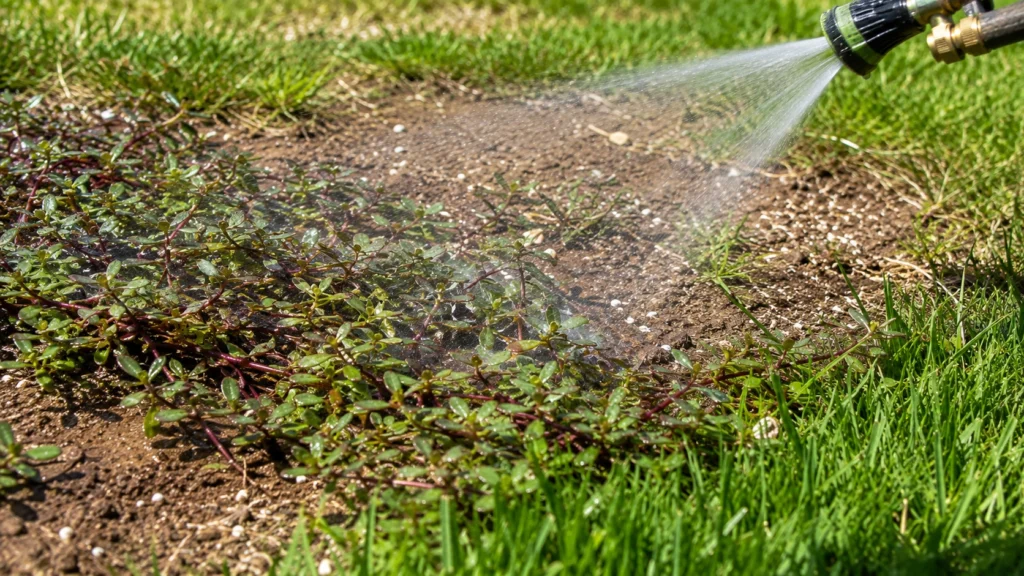
If your yard is covered, grab a post-emergent broadleaf herbicide containing 2,4-D, Dicamba, or Triclopyr (such as Ortho Weed B Gon or Gordon’s SpeedZone).
- Mix the liquid concentrate according to the label. For a standard Triclopyr blend, use 1 to 1.5 oz per gallon of water in a pump sprayer.
- Spray the leaves until uniformly wet, but not to the point of runoff.
- Timing your herbicide application correctly dictates your success, so always verify the best time to spray weeds before or after rain so your expensive product doesn’t wash away.
Step 4: Temperature Check
Most folks spot these flat weeds in late July, spray them with standard 2,4-D when the temperature is 95°F, and end up burning their surrounding turfgrass while the weed survives. Only apply these liquid chemicals when daytime highs are consistently below 85°F.
Expect the weeds to curl and wilt within 3 to 5 days, drying up completely in about two weeks. A typical DIY liquid treatment costs around $20 for the concentrate.
Professional vs. DIY
| Factor | DIY | Professional |
| Cost | $ | $$$ |
| Speed | 1–2 Weeks | 3–5 Days |
| Effectiveness | Moderate | High |
| Risk | Moderate | Low |
For most standard residential yards, handling spurge or purslane is a highly manageable DIY project. A $20 bottle of broadleaf herbicide concentrate and a basic 1-gallon pump sprayer will handle the job.
You need to call a professional when these weeds have completely overrun a newly seeded lawn or when the infestation covers more than 30% of your total yard. Pros have access to commercial-grade post-emergents that won’t fry delicate, immature turf in the summer heat. If you’ve sprayed an area twice and the mats keep spreading, stop. Applying more off-the-shelf product at this point will just contaminate your soil without killing the target. Call a certified local applicator.
The Third Possibility: Prostrate Knotweed
Homeowners constantly confuse these two with prostrate knotweed. Knotweed also grows completely flat against the ground, thrives in highly compacted soil along driveways, and has tiny, inconspicuous leaves.
To tell them apart, check the stems closely. Prostrate knotweed stems have a distinct, thin, papery sheath (called an ocrea) wrapping around each joint where a leaf attaches to the stem. Neither spurge nor purslane has this papery joint. Knotweed leaves are also blue-green and oval, lacking both the characteristic red spot of spotted spurge and the thick, water-filled succulence of purslane. Treating knotweed requires entirely different application timing and heavy core aeration, so getting the identification wrong means wasting hours of labor and expensive chemicals.
Prevention Tips
The most effective herbicide you can deploy is a thick, healthy lawn. Both of these weeds require direct sunlight hitting bare dirt to successfully germinate.
Overseed your bare yard patches in early fall so you have a dense turf canopy by the time next summer hits. Raise your mower deck to at least 3 inches or higher during the hottest months. Tall grass blades shade the soil, keeping it cool and suppressing dormant weed seeds. Adjusting your cutting height effectively shades out low-growing intruders, just make sure you know the specific rules on whether to mow before weed and feed applications to maximize your chemical defenses. Finally, apply a pre-emergent herbicide like Prodiamine in early spring.
Pro-Tips Box: In most cases I’ve seen in hot, dry climates, homeowners hand-pull spotted spurge without gloves and end up with contact dermatitis. Always wear nitrile gloves. If you’re dealing with a massive purslane invasion in landscape beds, skip the weak stuff and use a targeted application of Glyphosate mixed with 1 oz of methylated seed oil (MSO) per gallon. The MSO cuts right through the weed’s thick waxy cuticle. Spray it directly on the weed leaves using a cardboard shield to protect your nearby ornamentals.
People Also Ask
Is spurge poisonous to dogs?
Yes, spotted spurge is toxic to dogs and cats. The white milky sap irritates the skin, mouth, and stomach. If ingested, it causes vomiting, drooling, and diarrhea. Keep pets away from areas where spurge is actively growing until you kill it completely.
Can you eat common purslane?
Yes, common purslane is fully edible and packed with Omega-3 fatty acids. It has a slightly sour, salty, and lemony crunch. However, never eat purslane from a lawn that has been treated with chemical fertilizers or herbicides.
Does pulling purslane make it spread?
Yes. Purslane is a succulent that stores water in its leaves. If you snap a stem and leave a piece on the dirt, it will grow new roots and start an entirely new plant within a few days. Chemical control is much safer.
What to Read Next
Getting your weed identification right on the first try is the only way to avoid turf damage. Mistaking invasive grassy weeds for standard turf is just as common, which is why reviewing crabgrass vs tall fescue will save you from spraying the wrong chemical on the right grass.