
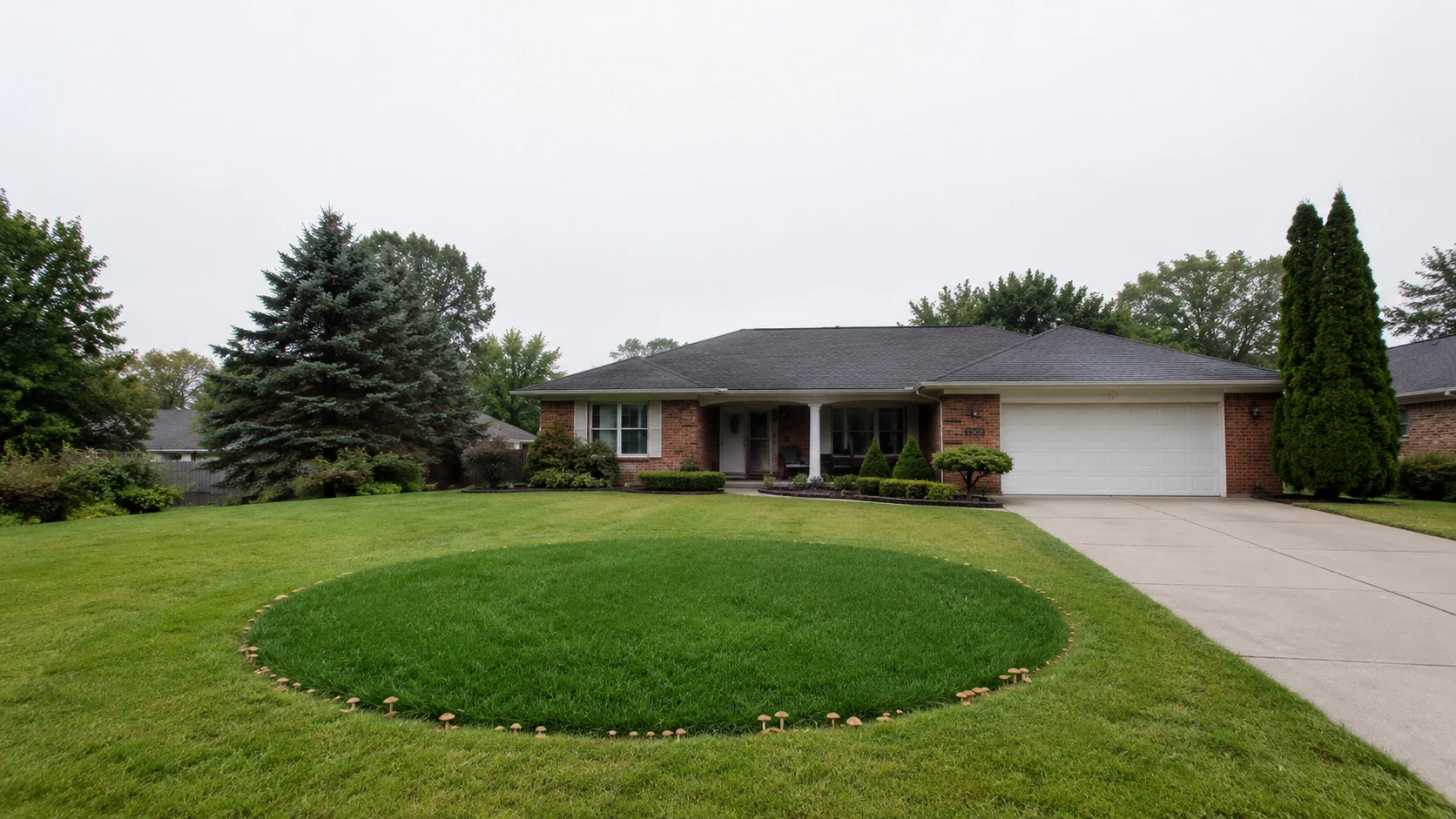
While European folklore claims that dark green circles of grass and sudden mushroom sprouts are the result of fairies dancing overnight or portals to the spirit world, the agronomic reality is entirely grounded in soil biology. A fairy ring is the visible symptom of soil-borne Basidiomycete fungi breaking down buried organic matter. As the underground fungal web (mycelium) expands outward uniformly in search of food, it releases nitrogen, causing that distinct dark green, rapid-growth ring on the surface before eventually rendering the soil highly water-repellent.
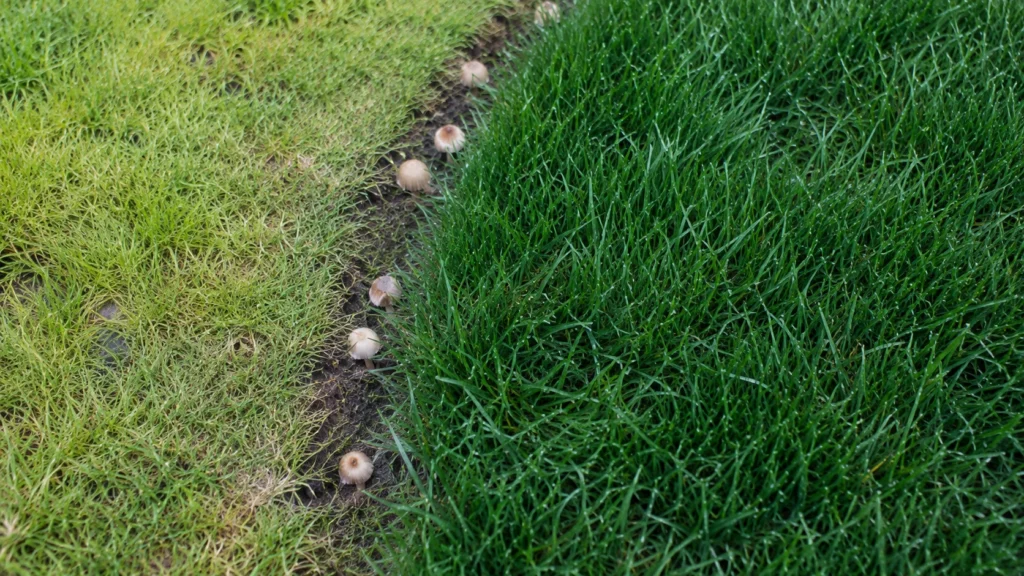
Identification & Misdiagnosis
Homeowners often panic when a 3-foot to 15-foot dark green or dead circle suddenly appears in the yard. In the field, we categorize fairy rings into three distinct types to determine the level of damage and the required treatment.
- Type 1: The most destructive. The fungal mycelium becomes so dense in the soil profile that it creates a hydrophobic (water-repellent) barrier. Grass roots die from drought, leaving a ring of dead, brown turf flanked by inner and outer rings of dark green, stimulated grass.
- Type 2: The soil is not yet hydrophobic. You will only see a prominent ring of dark green, fast-growing grass. The fungus is actively decaying organic matter and releasing a massive flush of nitrogen, essentially over-fertilizing that specific circle.
- Type 3: No dark green grass or dead turf is visible. The only sign is a circular ring of mushrooms popping up after heavy rains or periods of high humidity.
A common field error I see is misdiagnosing a Type 1 fairy ring as Necrotic Ring Spot or Brown Patch. Necrotic ring spot usually leaves a “frog-eye” pattern with healthy grass strictly in the center, and the dead patches rarely exceed 2 to 3 feet in diameter. Fairy rings can expand by 6 to 24 inches per year and have been known to stretch across property lines.
Root Causes & Attractants
The fungus causing a fairy ring does not attack the grass directly; it feeds on decaying wood and debris under the soil. The problems on the surface are secondary symptoms of what is happening underground.
- Buried Organic Matter: The primary food source. Old tree stumps, buried lumber from construction, dead tree roots, or thick accumulations of woody mulch mixed into the topsoil.
- Excessive Thatch: A thatch layer exceeding 0.5 inches provides a perfect damp, organic environment for the mycelium web to colonize just beneath the crown of the grass blades.
- Sandy Soils: Fairy rings thrive in sandy, fast-draining soils with low fertility. The lack of competing beneficial microbes allows the Basidiomycetes to dominate the soil profile.
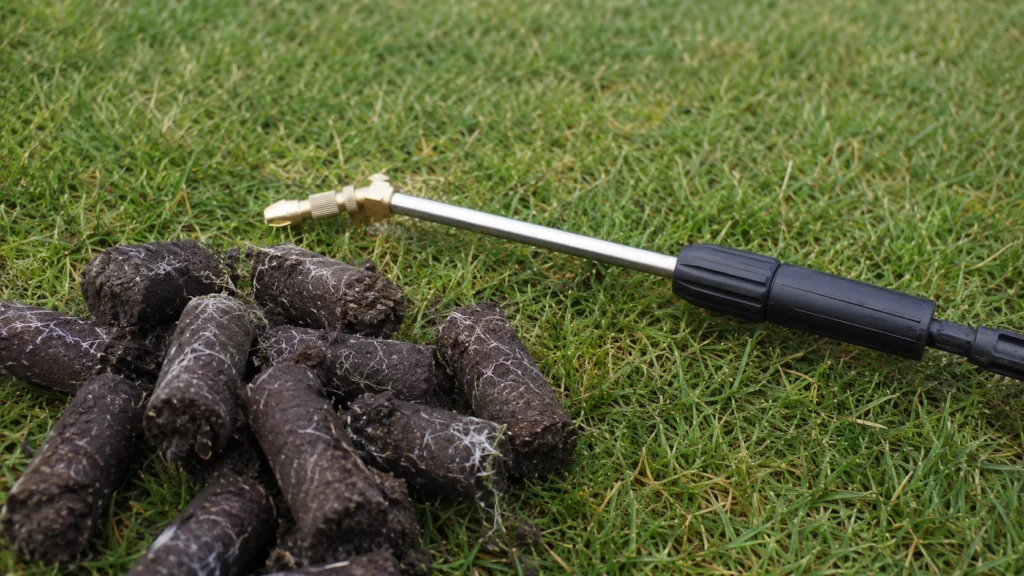
Pro-Tips Box: Most homeowners try to treat Type 1 rings by just running sprinklers longer. The mycelium secretes an organic acid that literally coats soil particles, making them act like freshly waxed car paint. Water runs right off. Before applying any fungicide or extra water, you must break that hydrophobic seal using a heavy-duty soil surfactant or a wetting agent like Tournament-Ready. Punching holes with a pitchfork isn’t enough; use a hollow-tine aerator to pull actual 3-inch plugs out of the ring.
Eradication Plan (Step-by-Step)
Eliminating the actual fungus is notoriously difficult because the mycelium can reach up to 3 feet deep into the soil. For Type 2 and Type 3 rings, masking the symptoms is often the most practical route. For a destructive Type 1 ring, physical and chemical intervention is mandatory.
Step 1: Mask the Green Ring (Type 2)
If you only have a dark green circle without dead grass, apply a fast-acting nitrogen fertilizer (like a 21-0-0 Ammonium Sulfate) to the rest of the lawn. Do not fertilize the ring itself. By raising the fertility of the surrounding turf, you blend the dark green ring into the background. Expect this to mask the issue within 7–10 days.
Step 2: Core Aeration
For a Type 1 ring with dead grass, you must physically break the hydrophobic barrier. Run a mechanical core aerator over the ring and 2 feet beyond its outer edge, making multiple passes. You need holes 2 to 3 inches deep spaced tightly together to open channels past the fungal mat.
Step 3: Apply a Soil Surfactant
Mix a commercial soil wetting agent in a pump sprayer. Apply it heavily to the aerated area. You want to use about 4 to 6 oz of surfactant per 1,000 sq ft, mixed in at least 2 gallons of water. Immediately soak the area with a hose for 15 minutes to push the surfactant deep into the aeration holes.
Step 4: Fungicide Application (Severe Cases)
If the ring persists and kills grass year after year, follow the surfactant drench with a systemic fungicide containing Flutolanil or Azoxystrobin (like Heritage G). Apply at the curative rate of 0.4 oz per 1,000 sq ft. The fungicide will travel down the aeration channels you created. Heavy watering immediately after application is required to move the chemical into the root zone before it dries on the blades.
Pet & Child Safety Warnings
When treating a fairy ring with commercial surfactants and systemic fungicides like Azoxystrobin, keep pets and children completely off the treated area during the heavy watering phase. The active chemicals are driven deep into the soil profile, but the surface must dry completely. Adhere to a strict 24-hour re-entry interval once the lawn is visibly dry to prevent dermal exposure or ingestion by dogs eating treated grass.
Professional vs. DIY
| Feature | DIY Approach | Professional Service |
| Cost | $40 – $80 | $150 – $300 |
| Speed | 1 – 2 weeks | 1 – 2 weeks |
| Effectiveness | High (Masking) | High (Chemical Eradication) |
| Risk | Low | Low |
For Type 2 and Type 3 rings, a DIY approach using nitrogen to mask the color difference and picking the mushrooms by hand is the smartest financial route. Most homeowners waste money buying cheap, big-box store fungicides and spraying them on the surface of a Type 1 ring, which does absolutely nothing because the chemical never penetrates the hydrophobic soil.
You need a professional when dealing with an aggressively expanding Type 1 ring that is wiping out large sections of expensive sod. Licensed technicians have access to specialized soil penetrants, heavier core aeration machinery, and commercial-grade DMI fungicides that are restricted from residential purchase.
Prevention Tips
- Remove Tree Stumps Completely: Never just grind a stump down 2 inches below the soil line and cover it with topsoil. Dig out as much of the root system and woody debris as possible before seeding.
- Manage Your Thatch: Core aerate your lawn annually and dethatch if the organic layer exceeds 0.5 inches. A clean soil surface deprives the Basidiomycete fungi of their primary food source.
- Maintain Consistent Fertility: A properly fertilized lawn rarely shows Type 2 rings. Implement a strict feeding schedule using slow-release nitrogen in the spring and fall.
People Also Ask
Are fairy ring mushrooms poisonous to dogs?
Many mushroom species associated with fairy rings, like the Fairy Ring Champignon, are generally non-toxic, but others can cause severe gastrointestinal distress in dogs. Always pull and discard mushrooms as soon as they appear to eliminate the risk entirely.
Can a fairy ring destroy my entire lawn?
A Type 1 fairy ring can kill massive swaths of turf by making the soil completely hydrophobic, depriving roots of water. While it won’t kill the entire yard overnight, left untreated, the ring will continue expanding outward year after year.
Will dish soap work as a soil surfactant?
Using dish soap is a frequent DIY mistake that can strip natural oils from grass blades and cause phototoxicity under direct sun. Always use a proper horticultural wetting agent formulated specifically to break the surface tension of hydrophobic soils without burning the turf.
What to Read Next
Understanding the exact type of fungus attacking your turf is half the battle, which is why knowing the difference between Brown Patch vs Dollar Spot can save you from misdiagnosing a simple moisture issue as a massive root zone failure.