
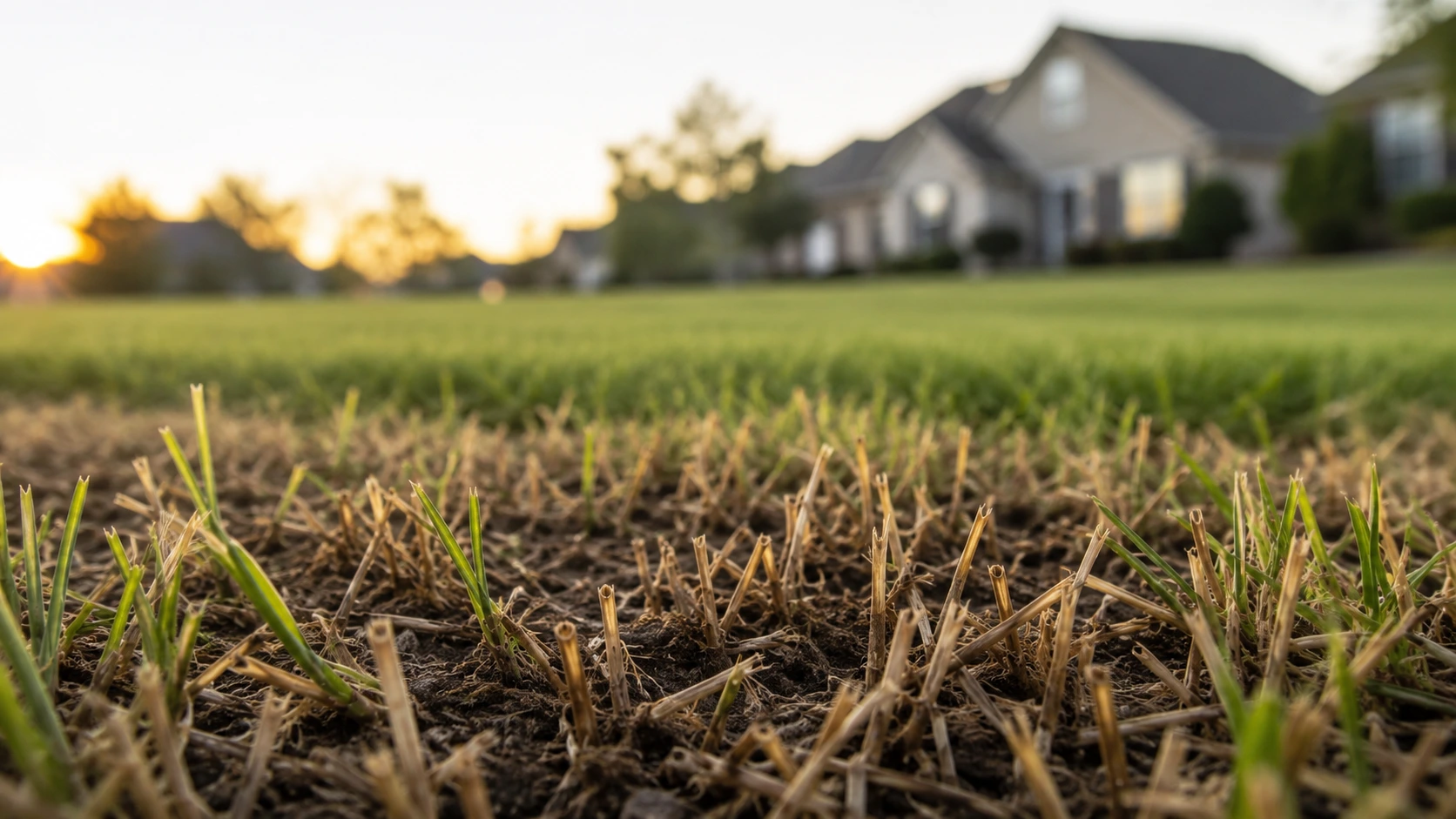
Bifenthrin and Clothianidin are the most effective curative active ingredients that kill adult billbugs on contact and eradicate active larvae in the thatch layer. For long-term prevention, applying a systemic insecticide like Imidacloprid in late spring kills newly hatched larvae before they can hollow out your turfgrass stems. Liquid applications offer the fastest knockdown for severe infestations, while watered-in granular formulas provide superior residual control in the soil throughout the summer.
Phase 1: Curative Knockdown for Active Adults
If your yard is actively turning brown in mid-summer and you spot hard-shelled, weevil-like adults walking on your sidewalks or driveway, you need an immediate contact killer. Bifenthrin (found in professional concentrates like Talstar P or consumer options like Ortho Bug B Gon) is the industry standard for halting an active surface infestation.
- Mix 0.5 to 1.0 fl oz of liquid Bifenthrin per gallon of water to treat 1,000 sq ft.
- Apply using a pump sprayer in the late afternoon or early evening when adult billbugs are most active on the surface.
- Leave the product to dry on the grass blades. Delay irrigation for at least 24 hours to maximize contact time with the insects.
- You can expect a significant drop in adult activity within 3 to 5 days.
Phase 2: Systemic Larval Control
Killing the adults stops the mating cycle, but the legless white larvae already buried in the turf will continue destroying your yard from the inside out. Stopping them requires a systemic insecticide that moves into the plant tissue, such as Imidacloprid (the active ingredient in BioAdvanced Season Long Grub Control).
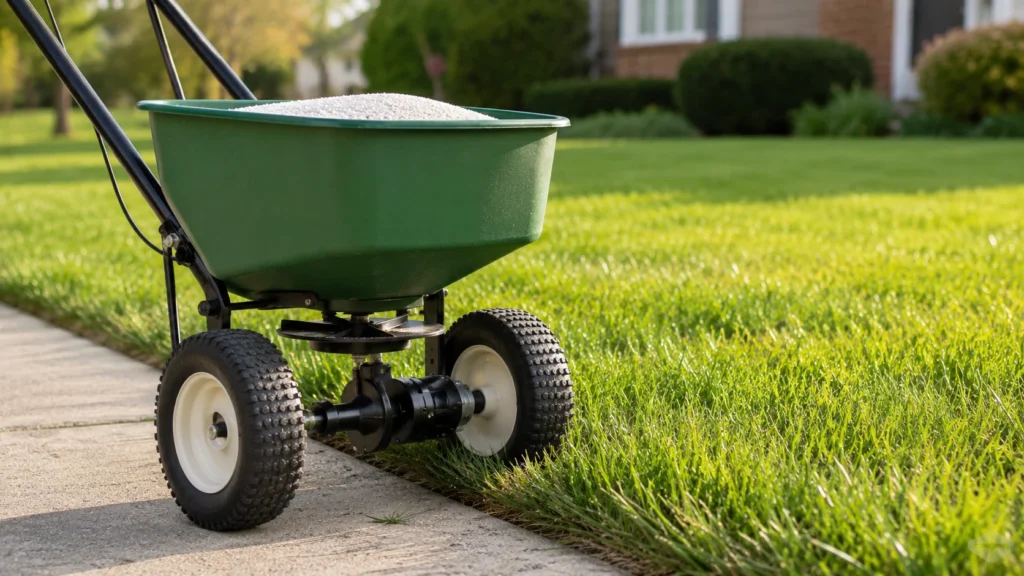
- Apply at a rate of 2.5 to 3 lbs of granules per 1,000 sq ft using a standard broadcast spreader.
- Water the yard immediately with at least 0.5 inches of irrigation. Imidacloprid is useless sitting on the surface; it must be pushed past the thatch layer and down into the root zone.
- This is not an overnight fix. Allow 10 to 14 days for the grass roots to absorb the chemical and for the feeding larvae to ingest a lethal dose.
Identification & Misdiagnosis
Billbug damage first appears as light green to yellow patches that quickly transition to completely brown, dead turf by mid-July or August. Because this coincides with the hottest part of the year, the most common error homeowners make is assuming the grass is just suffering from heat stress. They run their irrigation systems twice a day, keeping the soil constantly saturated. This massive mistake accelerates root rot on turf that is already fatally compromised by insect feeding.
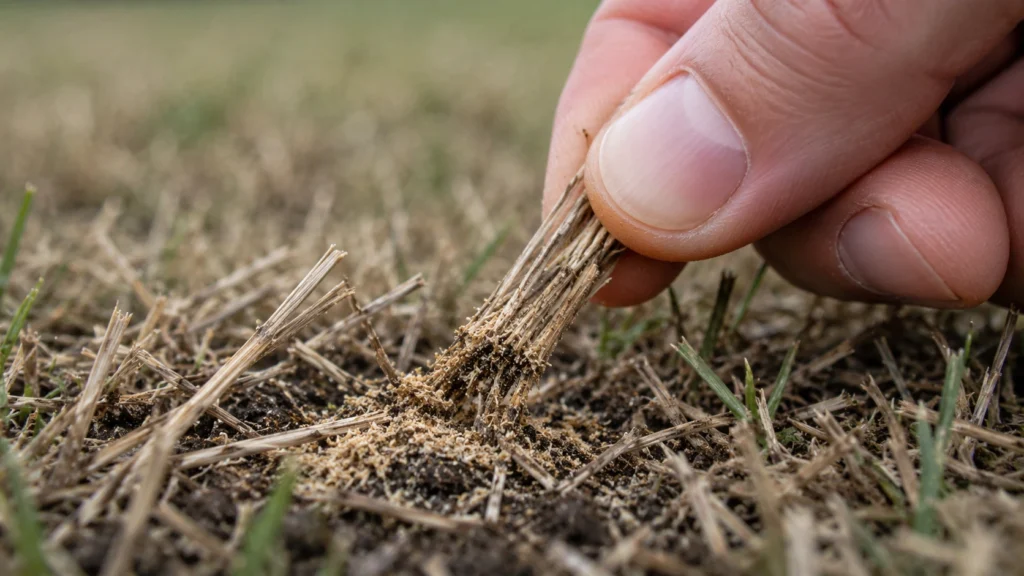
To confirm you are dealing with billbugs and not drought or a fungal disease like Brown Patch, perform the “tug test.” Grab a handful of the brown grass and pull upward. If it is drought stress, the roots will hold firm. If you have billbug damage, the grass stalks will break off easily at the soil line. Look closely at the broken ends. Billbug larvae hollow out the crown of the plant and leave behind a fine, sawdust-like material called frass.
Root Causes & Attractants
Billbugs thrive in highly manicured environments with excessive thatch. A thatch layer thicker than 1/2 inch acts as a protective shield for both adults overwintering in the yard and the larvae feeding near the surface. The organic buildup absorbs insecticides before they reach the soil, rendering cheap granular treatments almost entirely ineffective.
Grass species also dictates your risk level. In cooler northern states, Kentucky Bluegrass is the primary target for the Bluegrass Billbug. Down south, the Hunting Billbug aggressively attacks Zoysia and Bermuda lawns. If your yard consists entirely of susceptible cultivars, you face a much higher risk of total lawn loss during an outbreak.
Pet & Child Safety Warnings
Handling potent insecticides like Bifenthrin and Imidacloprid requires strict adherence to re-entry intervals (REI). When applying liquid contact killers, keep all dogs, cats, and children off the lawn until the chemical is completely dry. Depending on humidity and temperature, this usually takes between 2 to 4 hours.
For granular systemic treatments, the granules themselves pose an ingestion hazard. You must water the product in immediately with heavy irrigation. Keep the yard completely off-limits during the watering process and until the lawn has thoroughly dried. Once the granules dissolve into the soil matrix and the surface moisture evaporates, the area is safe for normal activity.
Professional vs. DIY
| Factor | Professional Treatment | DIY Approach |
| Cost | $85 – $150 per application | $30 – $60 for chemicals |
| Speed | 24-48 hours to schedule | Immediate action |
| Effectiveness | High (Commercial-grade actives) | Moderate to High (If timed right) |
| Risk | Low (Licensed applicator) | Moderate (Mixing/handling risks) |
Treating billbugs yourself is highly effective if you catch the problem in the adult stage before eggs hatch. Sourcing products like Talstar P and calibrating a backpack sprayer is well within the capabilities of a dedicated homeowner. The DIY route falls apart when misdiagnosis delays treatment until mid-August, at which point the larvae have already destroyed the root system and systemic granulars take too long to act.
I constantly see DIYers applying the wrong chemical at the wrong time—dropping preventive Imidacloprid on a yard that is already half dead from mature larvae. At that stage, you need restricted-use curative products that penetrate deep into the thatch rapidly. If your lawn is visibly deteriorating by the day and the tug test reveals heavy frass, a licensed pest control operator has access to faster-acting knockdown agents and proper calibration equipment to salvage the remaining turf.
Prevention Tips
- Dethatch your yard aggressively in early fall to remove the protective layer where adult billbugs overwinter.
- Aerate compacted soil to improve drainage, as excessive surface moisture encourages shallow root growth that is easily destroyed by feeding larvae.
- Overseed your lawn with endophyte-enhanced Perennial Ryegrass or Tall Fescue. These grasses contain a natural fungus that is highly toxic to billbugs and other surface-feeding insects.
- Apply a systemic granular insecticide containing Chlorantraniliprole (GrubEx) in late April to preemptively protect the root zone for the entire season.
Pro-Tips Box: To pinpoint the exact week you need to spray for adult billbugs, build a simple pitfall trap in early May. Bury a standard 16 oz plastic cup in the ground near the edge of your driveway so the rim is exactly flush with the soil surface and check it every morning. Once you find 2 or 3 adult billbugs trapped inside, you know they have emerged from overwintering and are actively moving through the turf, which is your cue to immediately apply a surface treatment of liquid Bifenthrin at 0.5 fl oz per gallon to wipe out the population before they can lay eggs.
People Also Ask
Do grubs and billbugs need the same treatment?
While systemic products like Imidacloprid work for both, timing differs. White grubs require treatment in late summer, whereas billbug prevention must be applied in late spring before the larvae enter the plant stems.
Will my grass recover from billbug damage?
Severely damaged turf rarely recovers because the larvae completely hollow out the plant crown. You will likely need to rake out the dead material and reseed the bare patches with new grass seed in the early fall.
What natural remedies kill billbugs?
Beneficial nematodes, specifically Steinernema carpocapsae, can hunt and kill billbug larvae in the soil without chemicals. You must apply them with heavy water in the evening to prevent UV degradation from sunlight.
What to Read Next
Using harsh granular insecticides to wipe out an infestation often raises concerns about yard usage, which is why understanding how long after fertilizing is it safe for dogs is crucial before you start applying heavy chemical treatments to your turf.