
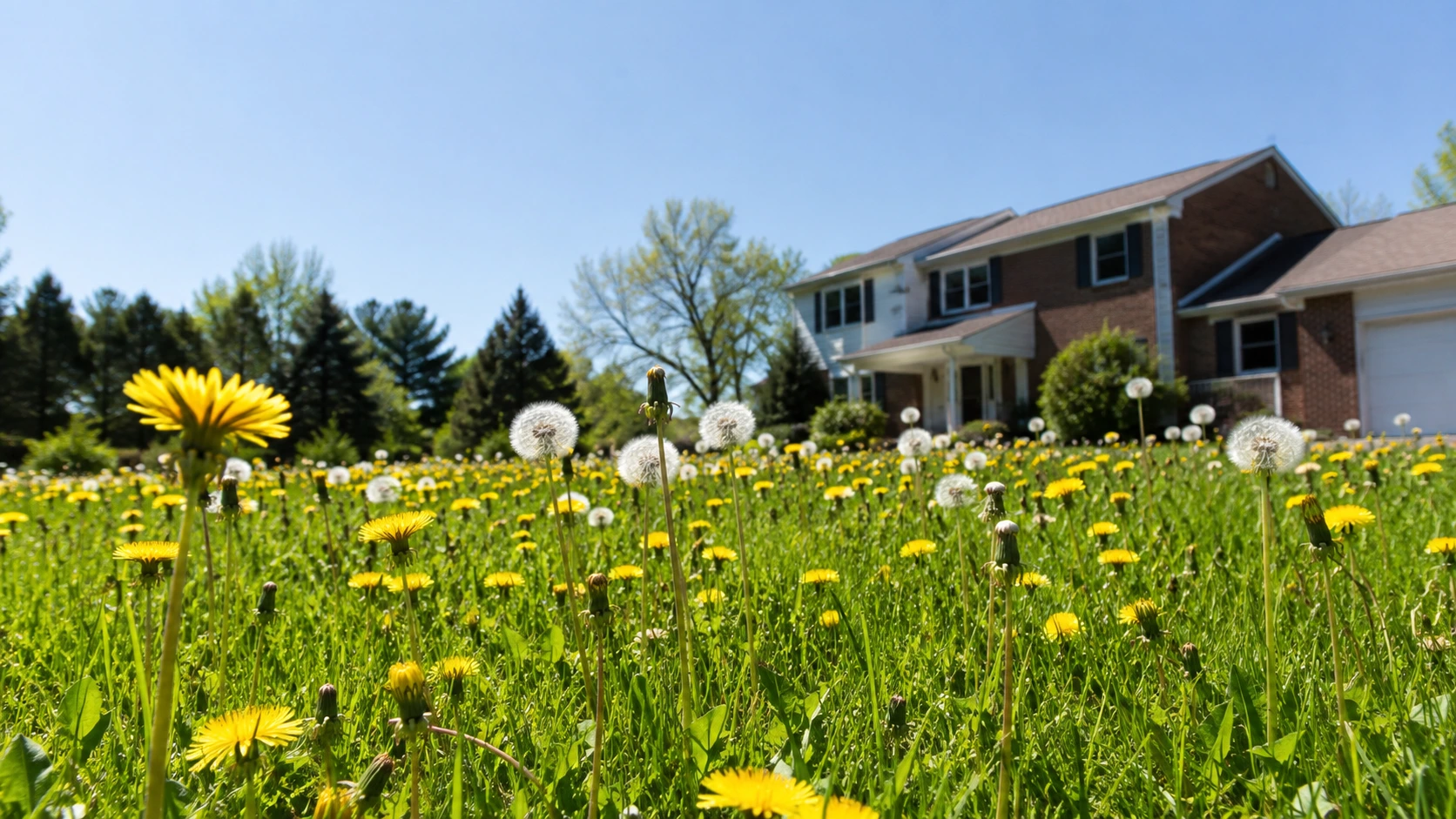
Dandelion and hawksbeard are broadleaf weeds that produce similar yellow flowers and fluffy seed heads, but their stems give them away. Dandelions have a single, hollow, unbranched stem with one flower and grow close to the ground. Hawksbeard features solid, highly branched stems that support multiple flowers per plant and grow significantly taller. Both require broadleaf herbicides for complete root elimination.
Identification Guide
- Stem Structure: Break the stem. A dandelion stem is a single, hollow tube that secretes a milky white sap and only ever holds one flower. Hawksbeard stems are solid, tough, and branch out to hold several yellow flowers on the same stalk.
- Leaf Shape and Placement: Look at the base of the plant. Dandelions form a flat rosette of deeply toothed leaves resting directly on the soil. Hawksbeard also has basal leaves, but you will see smaller, narrow leaves growing directly attached to the upper branched stems.
- Height: Dandelions stay relatively low, usually capping out around 6 to 12 inches tall. Hawksbeard shoots up aggressively, often reaching 1 to 3 feet in height if left unmowed.
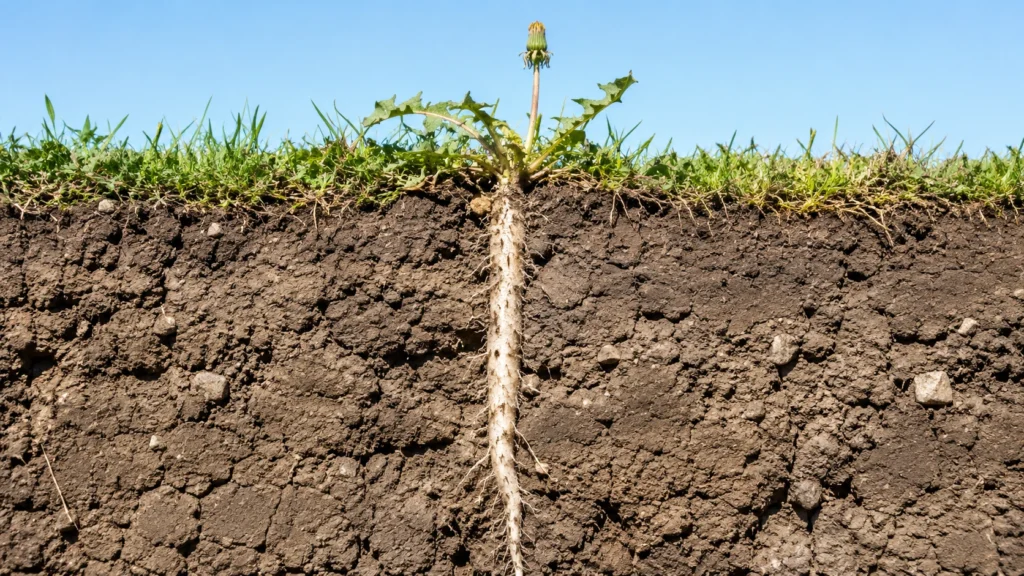
- Root System: Both rely on a deep taproot to survive drought and winter. A mature dandelion taproot is thicker, fleshier, and snaps very easily. Homeowners constantly snap dandelion taproots trying to pull them by hand, leaving the bottom half in the dirt. Within two weeks, two new crowns sprout from that severed root.
Root Causes
Broadleaf weeds do not just magically appear; they exploit weaknesses in your turf’s defense. Dandelion and hawksbeard seeds blow in on the wind, but they only take hold where your grass canopy is thin. Thin turf allows direct sunlight to hit the soil surface, triggering weed seed germination in early spring.
Compacted soil heavily favors these taprooted weeds. While your Kentucky Bluegrass or Fescue struggles to push fragile roots through hard, clay-heavy dirt, the aggressive taproots of dandelion and hawksbeard drill right through it. If you notice these weeds dominating high-traffic areas of your yard, the ground is likely too dense. Figuring out when should you aerate your lawn is your first mechanical line of defense against them.
Mowing too short is the second most common trigger. Scalping your yard down to 1.5 or 2 inches exposes the soil and stresses the turf. These weeds thrive in drought-stressed, undernourished yards. Once the soil temperature hits 50°F, dormant weed seeds leverage that extra sunlight and space to explode before your grass fully wakes up.
Step-by-Step Solution
Pulling mature taproots by hand is a losing battle. To permanently kill both dandelion and hawksbeard without damaging your grass, you need a selective post-emergent broadleaf herbicide containing 2,4-D, Dicamba, or Triclopyr.
- Choose the Right Herbicide: Pick up a liquid concentrate like Ortho Weed B Gon or Gordon’s SpeedZone. These formulas contain multiple active ingredients that translocate directly into the taproot. Avoid non-selective chemicals like Roundup (Glyphosate), which will completely kill your grass on contact.
- Mix the Solution: Wear chemical-resistant gloves. Fill your hand-held pump sprayer with exactly 1 gallon of water, then add 2.5 oz of the herbicide concentrate (always verify rates on your specific label). Swirl the tank gently. Do not overmix or double the dose. A hotter mix just burns the leaves immediately, sealing the plant off before the chemical can travel down to the root system.
- Check the Weather: Spray when ambient temperatures sit between 65°F and 85°F. If the temperature exceeds 85°F, the ester formulation in many herbicides will volatilize, drifting as a gas and damaging nearby ornamental shrubs or desirable grass. Ensure no rain is forecasted for at least 24 hours so the chemical has enough time to absorb.
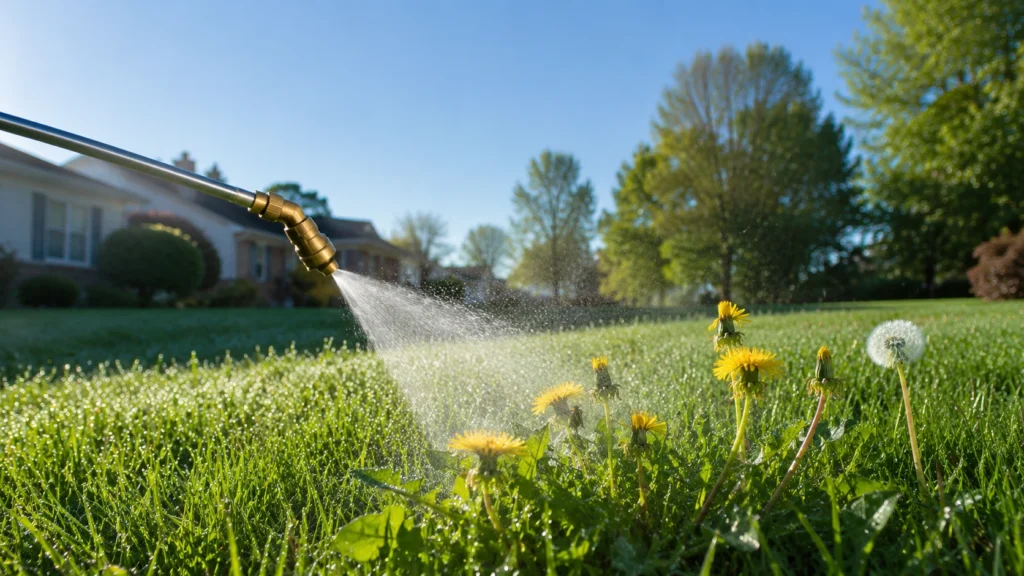
- Apply a Targeted Spray: Adjust your wand nozzle to a coarse spray pattern to prevent wind drift. Coat the leaves of the weeds until they are wet, but stop before the liquid runs off into the soil. You do not need to soak the ground. If you plan to apply fertilizer soon, check the rules on when to mow before weed and feed to maximize chemical contact on the broadleaf surfaces without stressing the turf.
- Wait and Monitor: The weeds will violently curl and wilt within 24 to 48 hours, but total root death takes 10 to 14 days. Leave the dying weed alone. Let the plant fully collapse and turn brown, ensuring the chemical has destroyed the deepest part of the taproot. Expect to spend $20 to $30 on a concentrate that will last multiple seasons.
Professional vs. DIY
Tackling a few yellow flowers is an easy weekend job. Most residential yards only need a basic spot treatment with consumer-grade products.
| Factor | DIY | Professional |
| Cost | $ | $$$ |
| Speed | Days | Weeks |
| Effectiveness | Moderate | High |
| Risk | Moderate | Low |
You should handle this yourself if you have scattered weeds popping up in spring. A $25 bottle of broadleaf weed killer and a handheld pump sprayer will do the trick. Call a professional if the weeds have entirely choked out the grass, or if you are dealing with a severe hawksbeard infestation spanning thousands of square feet. Commercial technicians have access to heavier-duty ester formulations that penetrate weed cuticles faster in cool spring weather, and they calibrate their sprayers to deliver exact ounces per 1,000 sq ft, minimizing turf damage.
Common Misdiagnosis
People constantly confuse dandelion and hawksbeard with Catsear (Hypochaeris radicata), also known as “false dandelion.” Catsear produces yellow, dandelion-like flowers, but its leaves are densely hairy, unlike the smooth, hairless leaves of a true dandelion or hawksbeard.
Sowthistle is another yellow-flowering weed that gets misidentified. You can tell sowthistle apart because its leaves wrap tightly around the main stem and have sharp, prickly edges similar to regular thistle. If you spray a basic 2,4-D mix on mature sowthistle thinking it is a dandelion, you will be disappointed. Mature sowthistle often requires a hotter mix containing Triclopyr to break through its tougher exterior. Always check the stem for branching and the leaves for hairs or prickles before mixing your chemical tank.
Prevention Tips
Thick grass is the ultimate pre-emergent. Raise your mower deck. Keep your cool-season grasses (like Fescue and Kentucky Bluegrass) at 3.5 to 4 inches tall during the growing season. This creates a dense canopy that shades the soil, blocking the sunlight that dormant weed seeds need to germinate.
Apply a pre-emergent herbicide containing Prodiamine or Dithiopyr in early spring before soil temperatures reach 55°F. While primarily used for crabgrass, a good pre-emergent barrier drastically reduces the number of broadleaf weed seeds that successfully establish. Water your lawn deeply and infrequently—about 1 to 1.5 inches of water per week, applied in a single morning session. Shallow, daily watering encourages shallow grass roots and creates a perfectly damp surface for wind-blown hawksbeard seeds to take hold.
Pro-Tips Box: Most homeowners apply post-emergents in the middle of a hot afternoon, which evaporates the chemical before it absorbs. I always spray broadleaf weeds at 7:00 AM when the dew is drying but the stomata (pores) on the weed leaves are wide open. If you are fighting a heavy hawksbeard infestation, add 0.5 oz of a non-ionic surfactant per gallon of your herbicide mix. Hawksbeard leaves are slightly waxy, and the surfactant breaks that surface tension so the chemical actually sticks and penetrates instead of beading up and rolling off into the dirt.
People Also Ask
Are dandelion and hawksbeard toxic to dogs?
No, neither dandelion nor hawksbeard are inherently toxic to dogs or cats. However, if your pet eats them immediately after you have applied a chemical herbicide, the chemicals pose a health risk. Always keep pets off treated grass until the liquid has completely dried.
Can you mow over dandelions to kill them?
Mowing will not kill dandelions or hawksbeard. It only cuts off the top foliage and the flower. The deep taproot survives underground and will simply push up new growth within a few days. You must extract or poison the root to permanently kill the plant.
Will vinegar kill hawksbeard and dandelions?
Horticultural vinegar (20% acetic acid) burns the visible leaves quickly, but it rarely kills the deep taproot. The weed usually regrows in a week. Vinegar is also non-selective, meaning it will completely scorch and kill any turfgrass it touches during application.
What to Read Next
Timing your chemical application perfectly makes the difference between dead weeds and wasted money, so check out our guide on the best time to spray weeds before or after rain to ensure your treatment actually sticks to the plant.