
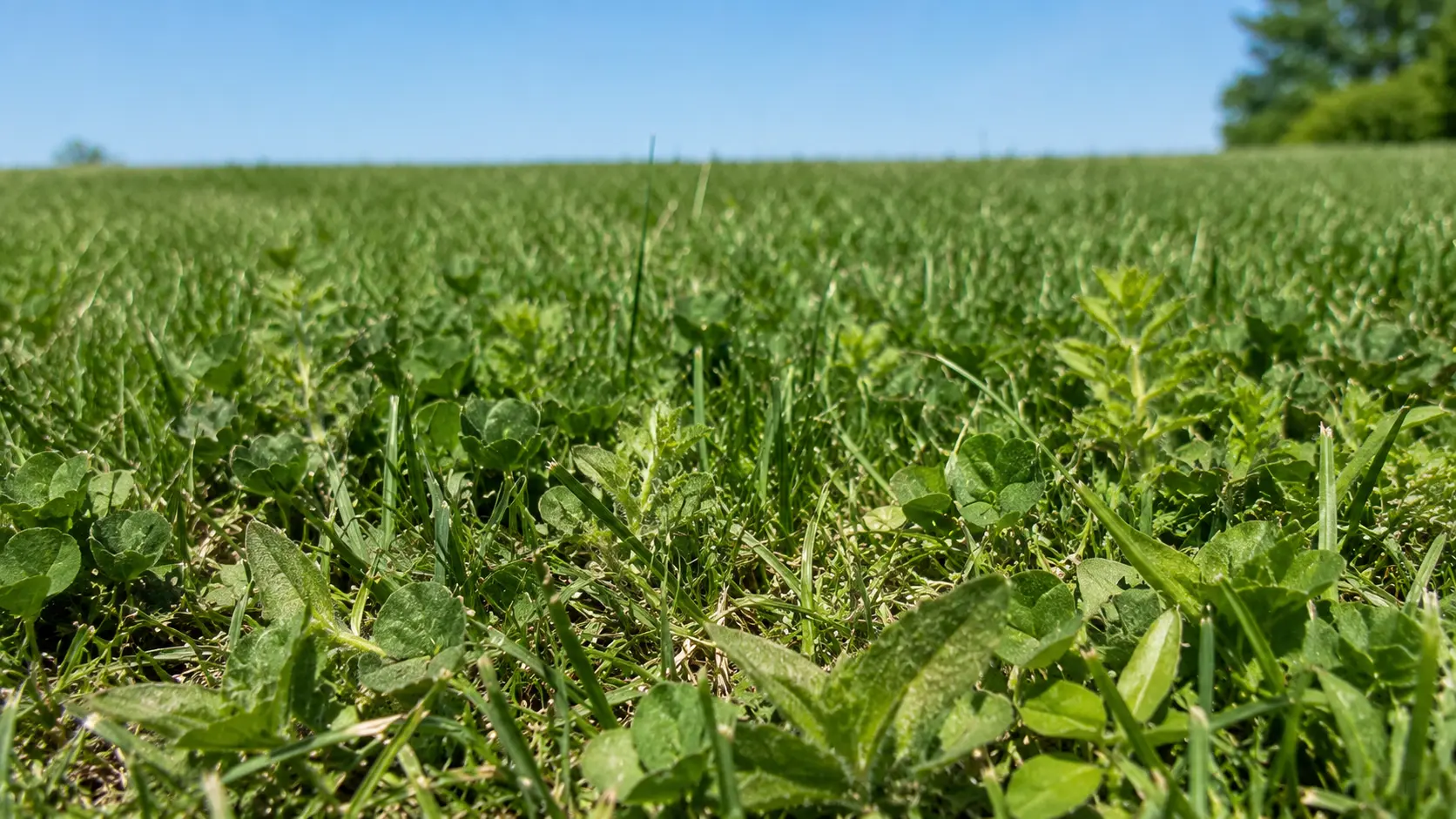
Oxalis and clover are entirely different broadleaf weeds that require specific chemical approaches to kill. Clover has three oval leaflets with a white watermark and thrives in nitrogen-depleted soil. Oxalis, or yellow woodsorrel, has three heart-shaped leaflets, produces yellow flowers, and features a deep, resilient taproot. You cannot eradicate oxalis with standard 2,4-D herbicides; you need a targeted application of Triclopyr combined with a non-ionic surfactant.
Identification & Misdiagnosis
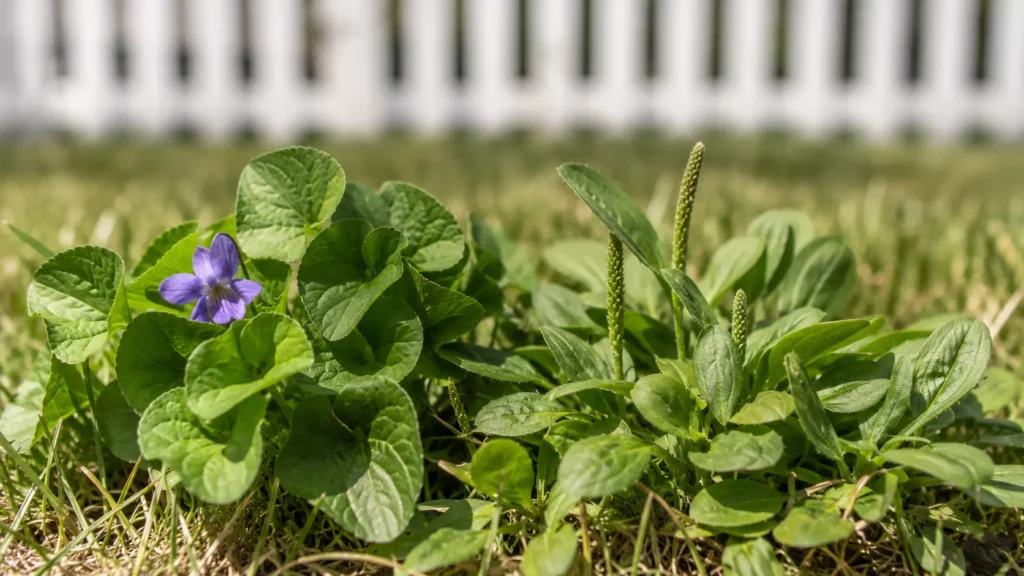
Homeowners constantly misidentify oxalis for clover, and this single mistake leads to hundreds of dollars wasted on the wrong herbicides. While both present as low-growing, three-leaf weeds in your turf, their biology and defense mechanisms are worlds apart.
White Clover (Trifolium repens)
- Leaf structure: Three oval or tear-drop shaped leaflets. You will usually see a faint, white crescent or “V” watermark across the center of each leaf.
- Flowers: Distinct white or pinkish spherical flower heads.
- Growth habit: Creeps along the soil surface using shallow stolons (runners).
- Defense: Roots at every node along the stolon, allowing it to form dense mats quickly.
Oxalis / Yellow Woodsorrel (Oxalis stricta)
- Leaf structure: Three perfectly heart-shaped leaflets that fold up at night or during extreme heat. No white watermarks.
- Flowers: Small, five-petaled yellow flowers.
- Growth habit: Grows slightly more upright and anchors into the soil with a tough, woody taproot.
- Defense: Seed pods act like tiny explosives. When brushed by a lawnmower or a foot, mature pods violently eject seeds up to 10 feet in every direction.
The most common field mistake I see is treating oxalis with a standard three-way herbicide (2,4-D, Mecoprop, and Dicamba). You spray the oxalis, the leaves curl up, and you assume the job is done. Two weeks later, the weed regrows from the surviving taproot development because the chemical never translocated deep enough.
Root Causes & Attractants
Weeds are indicator plants. Their presence tells you exactly what is failing in your soil chemistry or maintenance routine.
Clover is a legume that fixes its own nitrogen from the atmosphere. If clover is overtaking your Kentucky Bluegrass or Tall Fescue, your soil is severely deficient in nitrogen. The grass is starving and thinning out, while the clover creates its own food supply and aggressive overtakes the weakened turf.
Oxalis exploits physical weaknesses in your yard rather than chemical ones. It thrives in thin, dry, and compacted soils where grass struggles to root. You will almost always see oxalis outbreaks starting along the edges of concrete sidewalks and driveways. The soil in these zones bakes in the summer heat, stressing the grass and providing the perfect high-temperature environment for oxalis seeds to germinate.
Eradication Plan (Step-by-Step)
To kill both oxalis and clover simultaneously, Triclopyr is the active ingredient you need. Products like Ortho Weed B Gon Chickweed, Clover & Oxalis (which contains 8% Triclopyr) work for standard DIY applications. For heavy infestations, I use professional-grade formulations like Hi-Yield Triclopyr Ester.
1. Mixing the Tank and Surfactant
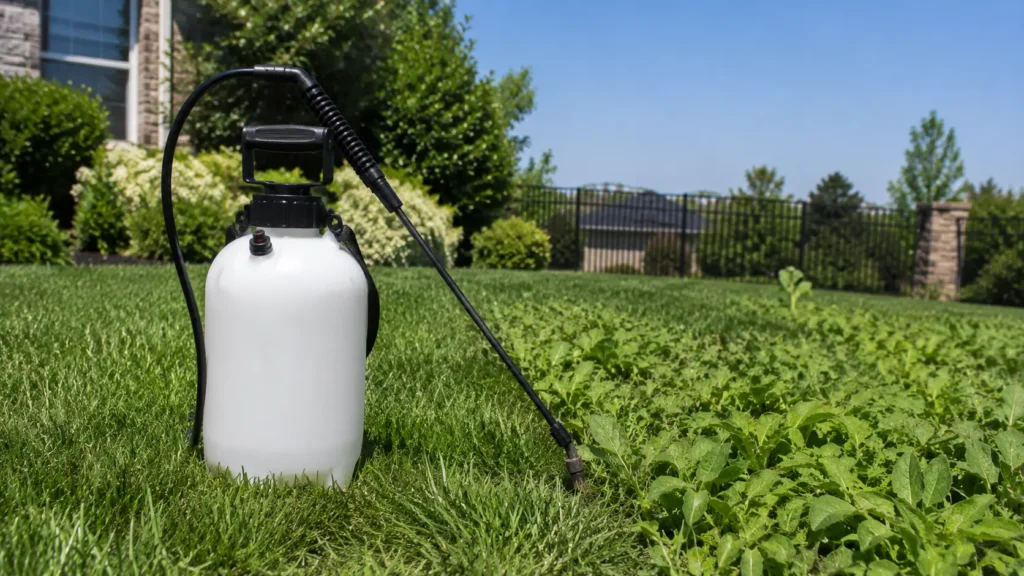
If using a concentrated Triclopyr product, mix 0.75 oz to 1 oz per gallon of water in a pump sprayer. Add your non-ionic surfactant (0.5 oz per gallon) last to prevent the tank from foaming over. Agitate the tank gently. One gallon of this mixture will effectively spot-treat roughly 500 sq ft of weeds. Cost per application runs around $5 to $8 in chemical usage.
2. Application Timing and Temperature Limits
Spray in the morning when the dew has dried but before the afternoon heat peaks. Do not apply Triclopyr ester on warm-season grasses like Bermuda or St. Augustine if temperatures exceed 85°F. You will torch your lawn. If you live in a southern state facing high summer heat, switch to a Sulfentrazone and Quinclorac blend, which is much safer for warm-season turf under heat stress.
3. Post-Treatment Expectations
Triclopyr works slowly. In my experience, customers panic when the weeds aren’t dead in 24 hours. You will see the stems twist (epinasty) within 3 to 5 days. Full eradication of the oxalis taproot and clover stolons takes 10 to 14 days. Do not mow the treated area for at least two days after application to ensure the chemical is fully absorbed into the plant’s vascular system.
Pet & Child Safety Warnings
Any application of Triclopyr or 2,4-D requires strict adherence to re-entry intervals. Keep all dogs, cats, and children off the treated lawn until the liquid has completely dried. In standard summer conditions (75°F and low humidity), drying takes about 2 to 3 hours. If you apply the herbicide on a humid, overcast day, extend that wait time to 4 to 5 hours. Wet chemical transfer can cause mild to moderate skin irritation and gastrointestinal upset if ingested by pets grooming their paws. Always read the active ingredient restrictions on your specific product label before spraying.
Professional vs. DIY
| Feature | DIY Triclopyr Treatment | Professional Weed Control Service |
| Cost | $25 – $40 (Chemical + Sprayer) | $65 – $120 per application |
| Speed of Action | 10–14 days | 7–10 days (commercial formulations) |
| Effectiveness | High for spot treatments | Very high for full-property takeovers |
| Risk | High (risk of turf burn if misapplied) | Low (calibrated equipment) |
Handling a few patches of clover or oxalis is a straightforward DIY weekend project. If you buy the right active ingredient and respect the temperature limits, you can clear your yard effectively.
You need to hire a professional operator if oxalis and clover cover more than 40% of your lawn. At that level of infestation, spot spraying becomes impossible, and a broadcast application is necessary. Professionals have access to restricted-use pre-emergents like Isoxaben (Gallery) that stop broadleaf weeds from germinating in the first place, something most big-box store products cannot reliably do.
Prevention Tips
- Spoon-feed Nitrogen: Apply a slow-release nitrogen fertilizer (like Milorganite or a Scotts Turf Builder) in the spring and early fall. Pushing dense grass growth naturally chokes out clover and removes its low-nitrogen advantage.
- Mow High: Set your mower deck to 3.5 to 4 inches for cool-season grasses (Fescue, Bluegrass). Tall grass shades the soil, dropping the soil temperature and depriving oxalis seeds of the sunlight they need to germinate.
- Apply Fall Pre-emergents: Standard spring pre-emergents (like Prodiamine) target crabgrass. To stop oxalis and clover, apply a broadleaf-specific pre-emergent in the early fall before soil temperatures drop below 70°F.
People Also Ask
Will pulling oxalis by hand get rid of it?
No. Hand-pulling usually snaps the stem above the soil line, leaving the deep taproot intact. The plant will rapidly regrow from the root, and the physical disturbance often triggers surrounding seed pods to explode.
Can I use granular weed and feed to kill clover?
Granular herbicides are highly ineffective against clover. The granules easily bounce off the small, smooth leaves and fall into the soil. Liquid herbicides with a surfactant provide the necessary foliar coverage for a kill.
Does horticultural vinegar kill oxalis permanently?
Vinegar only burns off the top foliage (contact kill). It does not translocate into the root system. The oxalis will temporarily turn brown but will push new green growth within a week.
What to Read Next
Stopping these aggressive weeds before they even break the surface of your soil is the most efficient way to manage a lawn, which is why knowing exactly what is pre emergence herbicide and how to apply it correctly before the season starts makes all the difference.